Traditional Indian games every child should learn

Games that need no equipment, no app and no adult refereeing — and that half of Indian children no longer know how to play.
Running and chasing games
Kho-kho: two teams, one chasing, one dodging, with seated chasers tagged in by a slap on the back and the word 'kho'. Builds sprinting, agility and split-second decisions. Needs eight or more players and a rough rectangle.
Kabaddi: a raider crosses into the other half chanting, tags opponents and returns without being caught, all on one breath. Needs a flat surface and no equipment at all.
Langdi: hopping on one leg to tag others. Brutal on the thighs and hilarious. Two or more players.
Chain tag (zanjeer): whoever is tagged joins hands with the tagger, and the chain grows until everyone is caught — a natural cooperative game hidden inside a chasing one.
Aim, skill and hand games
Pittu or lagori: a stack of seven flat stones, knocked down with a ball by one team, who then try to rebuild it while the other team hits them with the ball. Needs a ball, stones and a courtyard.
Gilli-danda: a small stick flicked into the air with a longer one and struck as far as possible. Excellent hand-eye coordination, and it needs space and care — this is the one where windows get broken.
Kanche (marbles): flicking marbles at a target with the thumb. Fine motor control, geometry, and the oldest gambling instinct in childhood.
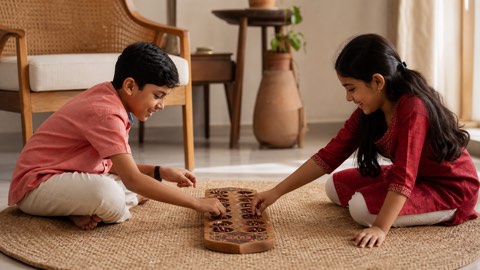
Lattu (spinning top), and pachisi or chaupar, the ancestor of ludo, played with cowrie shells or dice on a cloth board.
Indoor and courtyard games
Stapoo or hopscotch: chalk grid, a flat stone, and hopping without touching the lines. Balance, counting and turn-taking.
Chhupan chhupai (hide and seek), which needs nothing and works from about three.
Antakshari: singing in turns, each song starting with the last letter of the previous one. Family game, long car journeys, and vocabulary practice by accident.
Vish-amrit, statue, and the various clapping games with rhymes that pass from cousin to cousin and are learnt nowhere else.
Carrom and ludo, which have survived better than the outdoor games because they fit inside a flat.
Frequently asked questions
We live in a flat with no space.
Hopscotch, hide and seek, antakshari, carrom, ludo, kanche and clapping games all work indoors or in a corridor. The building compound covers most of the rest.
My child finds them boring compared with a screen.
Expect that for the first two or three sessions, and play with them rather than sending them out. These games need a group to become fun, and the group needs starting.
Are they safe?
Gilli-danda needs open space and no spectators nearby. Kabaddi and kho-kho need a soft surface rather than concrete. Otherwise they are as safe as any running around.
Who will teach them?
Grandparents, usually, and it is one of the better things to ask them to do. Most remember the local rules, which vary from street to street.
Reviewed by
- Nakul Phatak — CEO, theAsianparent India & IndonesiaHead of theAsianparent India; father of one
- Roshni Chugani — Head of Marketing, theAsianparent India & Singapore12 years in the mother-and-baby space; mother of two
Published by: theAsianparent editorial team