Pregnancy week 20: halfway

Twenty of forty. As much road behind as ahead — a week for pausing, filing, and looking both ways.
The halfway stone
Today you stand exactly in the middle — as many weeks passed as remain. A day to look back: the nausea weeks, the two-line morning, the flickering scan, the first flutter — how much has already happened.
And to look ahead: from here, every week is a weight-gain week for the baby. The story so far was construction; the story ahead is growth — and with it, the load on you. These remaining second-trimester weeks are the most valuable.
On paper too it's a midpoint — the anomaly scan's window centres here, and its report sets the coming months' course.
Your baby this week
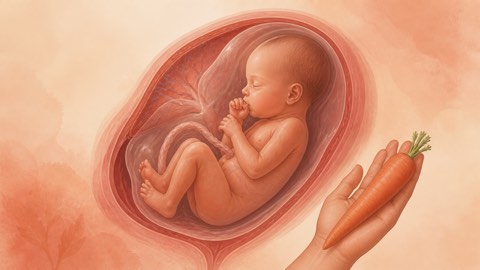
The baby measures banana-length — about twenty-five centimetres crown to heel, past three hundred grams. (From this week measurement runs head to heel — until now it was head to rump, which is why the number suddenly jumps.)
Swallowing practice is in earnest — the baby drinks amniotic fluid, tastes it, and the gut rehearses digestion. The first stool — meconium — is accumulating; it becomes that first black-green nappy after birth.
Skin layers are building, fat is accelerating, and behind the milk-teeth buds, the permanent teeth's buds are already forming — preparation that far ahead.
Read next

Changes in your body
The uterus's top edge is at the navel now — from here it climbs about a centimetre a week. The fundal-height number will roughly track the week count: twenty centimetres at twenty weeks.
Breathlessness, heartburn and hip pulls are settling in as regulars. They aren't cured; they're managed — and you've learned the management.
Evening ankle swelling may appear after long days on your feet. Feet up in the evening, salt sensible, water full — that's ordinary swelling. Sudden swelling, face-and-hands swelling, or one-sided swelling is the other kind — that's in the warning list.
What to do this week
Get the anomaly report explained line by line — especially placenta position and fluid volume. Photograph the report; paper gets lost, phones don't.
Do the halfway audit: is the weight on the doctor's track? What was the last haemoglobin? Are the IFA and calcium actually going in daily? Carry the three answers to the next visit.
Fix the sugar-test (GTT) date now — the window is 24-28 weeks. It's a fasting test that takes two-three hours; plan that morning's logistics in advance.
Start the name list — the halfway celebration and the household's sweetest argument. Both boy and girl columns; whoever arrives, a name should be waiting.
Week 20 at a glance
The week's essentials in one place. Your doctor may adjust these for your situation.
| Item | In week 20 |
|---|---|
| Main event | Halfway — 20 behind, 20 ahead |
| Baby's size | Banana-length — 25 cm, 300+ g |
| Baby is doing | Swallowing and tasting; meconium accumulating |
| Your body | Uterus at the navel; fundal height ≈ week count |
| The report | Anomaly scan — every line explained |
| Next date | GTT (sugar test) — book for 24-28 weeks |
| Homework | The name list — both columns |
When to see a doctor at once
The standing list — bleeding, persistent pain, high fever, urinary burning, sudden watery discharge, one-sided calf swelling: same-day.
Memorise the triad from here: severe headache + visual flashes + sudden face-hand swelling. That is pre-eclampsia's warning — the three together mean a BP reading now, not tomorrow morning.
This article is general information only and no substitute for personal medical advice. The person who can advise you knowing your health, your medicines and your previous pregnancies is your obstetrician, or the doctor at your nearest health centre.
Work out your due date
Enter the first day of your last period and your cycle length — your estimated due date, this week's count and the anomaly scan window all appear right here.
It is only an estimate — most babies aren't born on the exact date. A first-trimester scan dates a pregnancy more accurately; in the end, your doctor's date is the one that counts.
Frequently asked questions
Only 300 grams at halfway? How does this become three kilos?
That's the whole design. Growth's real speed arrives in the third trimester — the final ten weeks add more than half the birth weight. The first half built the machine; the second half runs it.
Someone saw the scan and said the baby is 'lying low'
worry? — The baby floats and turns freely; its position now means nothing. What matters is the placenta's position, and that's written in the report — ask the doctor about that line instead.
Should I stop bending for chores
mopping, buckets? — Don't stop; change technique. Bend at the knees, no jerks, hand the heavy bucket over. Daily housework helps a normal pregnancy — harm comes from method, not work.
Twenty weeks and I'm still not sure I feel movements
problem? — Not by itself. An anterior placenta cushions everything, and first-time recognition is late anyway. With a normal anomaly scan, relax — but past week 22 with still nothing, do tell the doctor.
Sources
Every clinical figure on this page is taken from the guidelines below. Where our numbers and your doctor's differ, ask which guideline they follow.
- WHO. WHO recommendations on antenatal care for a positive pregnancy experience (2016)Supports the recommendation that iron and folic acid (IFA) supplementation should be taken daily throughout pregnancy, and that routine antenatal visits include haemoglobin monitoring and weight tracking.
- NICE. Antenatal care (NG201) (2021)Supports the description of the mid-pregnancy anomaly scan (offered around 18–21 weeks) as including assessment of placental position and liquor (amniotic fluid) volume, and supports fundal height measurement as a routine antenatal assessment.
- ACOG. ACOG Practice Bulletin No. 190: Gestational Diabetes Mellitus (2018)Supports the instruction to schedule the glucose tolerance test (GTT) between 24 and 28 weeks of gestation.
- ACOG. ACOG Practice Bulletin No. 222: Gestational Hypertension and Preeclampsia (2020)Supports the warning that the triad of severe headache, visual disturbances, and sudden swelling of the face and hands are warning signs of pre-eclampsia requiring immediate blood pressure assessment.
- MoHFW. Pradhan Mantri Surakshit Matritva Abhiyan (PMSMA) — Antenatal Care Guidelines (2016)Supports the halfway audit items — haemoglobin check, daily IFA and calcium supplementation, and weight monitoring — as components of routine government-recommended antenatal care in India.
- NHS. You and your baby at 20 weeks pregnant (2023)Supports the description of fetal size at 20 weeks (approximately banana-length, around 25 cm crown to heel), the shift from crown-rump to crown-heel measurement from this point, and swallowing of amniotic fluid as active fetal behaviour at this stage.
Reviewed by
- Nakul Phatak — CEO, theAsianparent India & IndonesiaHead of theAsianparent India; father of one
- Roshni Chugani — Head of Marketing, theAsianparent India & Singapore12 years in the mother-and-baby space; mother of two
Published by: theAsianparent editorial team