Pregnancy week 21: kicks the outside world can feel

Until now the movements were yours alone. From this week they can be shared — a palm on the bump can catch a kick. The first direct bridge.
The first time someone else felt it
An evening comes — often around this week — when a kick lands so clearly you grab a hand: 'Here, quick!' And for the first time, someone else feels it too.
In that moment, for the father, the pregnancy turns from news into a child. Everything until now lived in reports and scan printouts; now, a thump against the palm. The grandmothers' queue forms the same day — be ready.
For the baby these kicks are gym work — muscle and bone strengthen through exactly this shoving. Every kick is good news, and its growing force is better news.
Your baby this week
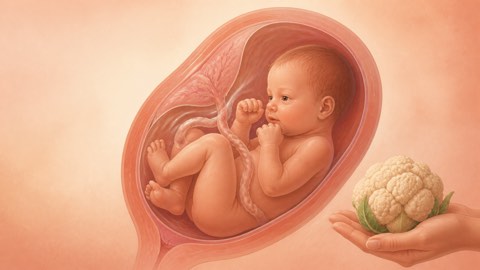
The baby is carrot-length — about twenty-seven centimetres, pushing three hundred and fifty grams. Eyebrows and eyelashes are complete; scalp hair is coming in.
The bone marrow is taking over blood-cell production — the permanent factories coming online after the liver and spleen ran the early shift.
Swallowed fluid is now delivering small amounts of sugar — the whole feeding-digesting apparatus in slow rehearsal. Taste buds keep sampling your menu through the fluid.
Read next


Changes in your body
For many women this is the best stretch of all — energy fine, bump manageable, movements for company. Use it: what gets postponed to the third trimester doubles in weight.
Evening swelling and vein prominence may increase. Don't sit with feet hanging — rest them on a stool; and long cross-legged sitting gets uncomfortable — keep changing position.
Stretch marks may make their entry — belly, thighs, breasts. They start red-purple and fade to silver. Moisturiser for the itch; savings intact against 'removal' promises.
What to do this week
Raise the father's daily duty — a hand on the bump and two sentences every night. His voice belongs in the set the baby will recognise at birth. This ritual tends to become the family's favourite.
GTT date confirmed? The 24-28 window nears. The night-before fast means picking a date with a calm morning after.
Fix the delivery hospital now — 24-hour labour cover, caesarean and newborn-care capability if needed, distance from home. See two, choose one, tell the whole household.
Get the workplace plan on paper — leave from when, handover to whom, return thinking. Ask HR about the maternity-benefit application process now; the last-month scramble is avoidable.
Week 21 at a glance
The week's essentials in one place. Your doctor may adjust these for your situation.
| Item | In week 21 |
|---|---|
| Main event | Kicks felt from outside — the father's first contact |
| Baby's size | Carrot — 27 cm, ~350 g |
| Forming | Eyebrows, lashes; marrow starts blood work |
| Possible symptoms | The good stretch; evening swelling, stretch marks |
| To fix | The delivery hospital — facilities checked, now |
| Approaching | The GTT window (24-28) |
| New ritual | Papa's two sentences to the bump, nightly |
When to see a doctor at once
The standing list — bleeding, persistent pain, high fever, urinary burning, sudden watery discharge, calf swelling: same-day. The pre-eclampsia triad (headache + flashes + sudden swelling) stays in memory.
Regular rhythmic belly-tightening — painful or not — is not normal at this stage. Tightenings coming at steady intervals several times a day get same-day mention; that's how preterm activity is caught.
This article is general information only and no substitute for personal medical advice. The person who can advise you knowing your health, your medicines and your previous pregnancies is your obstetrician, or the doctor at your nearest health centre.
Work out your due date
Enter the first day of your last period and your cycle length — your estimated due date, this week's count and the anomaly scan window all appear right here.
It is only an estimate — most babies aren't born on the exact date. A first-trimester scan dates a pregnancy more accurately; in the end, your doctor's date is the one that counts.
Frequently asked questions
The kicks land in the same spot daily
why? — The baby has a favourite position for now; where the feet point, the thumps land. The position changes over weeks, and the kicks' address with it.
My husband puts his hand on and the baby stops
every time! — A famous joke and half true: the warm pressure often soothes the baby, and eager waiting rarely matches the baby's own schedule. Try the post-dinner chatty hour.
Should I stop climbing stairs?
No. In a normal pregnancy stairs are exercise, not danger — hold the rail, take your time, ask for company on dizzy days. If your doctor has specifically said no (placenta or cervix reasons), that's different.
I feel shy talking to the bump
does it matter? — Talking matters; the style doesn't. Read headlines aloud, narrate the day, play bhajans — the baby wants your voice's rhythm, not your script. The shyness fades by the tenth try.
Sources
Every clinical figure on this page is taken from the guidelines below. Where our numbers and your doctor's differ, ask which guideline they follow.
- WHO. WHO recommendations on antenatal care for a positive pregnancy experience (2016)Backs the recommendation that warning signs including bleeding, persistent pain, high fever, sudden watery discharge, and calf swelling warrant same-day assessment, and supports the glucose tolerance test window of 24–28 weeks as part of routine antenatal screening.
- NICE. Antenatal care (NG201) (2021)Supports the 24–28 week gestational diabetes screening window, the pre-eclampsia warning triad (headache, visual disturbances, sudden swelling), and the advice that regular, rhythmic, painful uterine tightenings at this stage require same-day assessment as possible preterm labour.
- ACOG. ACOG Practice Bulletin No. 190: Gestational Diabetes Mellitus (2018)Confirms the 24–28 week window for gestational diabetes testing (GTT), consistent with the page's instruction to confirm a GTT date as this window approaches.
- IAP. IAP Standard Treatment Guidelines: High Risk Pregnancy (2022)Supports the pre-eclampsia warning signs (headache, visual flashes, sudden swelling) and the clinical guidance that regular rhythmic uterine tightenings before term should prompt same-day medical review as potential preterm labour activity.
Reviewed by
- Nakul Phatak — CEO, theAsianparent India & IndonesiaHead of theAsianparent India; father of one
- Roshni Chugani — Head of Marketing, theAsianparent India & Singapore12 years in the mother-and-baby space; mother of two
Published by: theAsianparent editorial team