Pregnancy week 36: early term at the door

Seven days from now the word 'preterm' retires — thirty-seven weeks is early term. This week settles the position question and lines up the final checks.
The last preterm week
Thirty-six is a boundary week: after it, birth is no longer 'preterm'. From thirty-seven the textbooks say 'early term' — the baby is considered ready, with the last two-three weeks adding polish rather than necessity.
This is also decision week for position: the check now tells whether the head is down. Head-down (the huge majority): carry on. Breech: today's the day the doctor lays out the options — the turning procedure (ECV), positions that may help, or a planned caesarean — calmly, with days in hand.
The mood instruction for the household: from here, treat every day as possibly the day, and none of them as necessarily the day. Bag by the door, phone charged, plans light.
Your baby this week
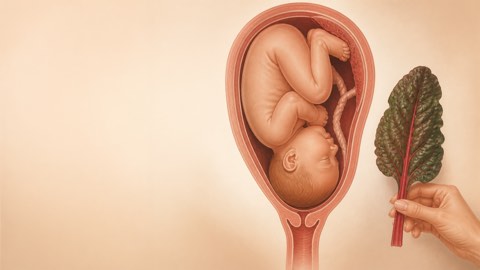
The baby is about forty-seven centimetres, around two and three-quarter kilos — shedding the last lanugo and building the final fat. The cheeks are fully commissioned.
The lungs are essentially ready; the digestive system is loaded (meconium waiting); the immune stocking continues to the last day. What remains is weight and days.
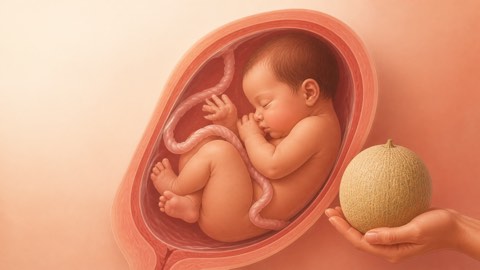
The head is deep in the pelvis for most now — the 'watermelon walk' is the visible evidence. Movements are strong squirms and presses; the count carries on to the final morning.
Read next

Changes in your body
The weekly check may now include an internal exam if indicated — cervix softening and opening can begin weeks before labour. 'One centimetre' at thirty-six means preparation, not countdown; don't let the number start a panic or a party.
Appetite may return as the bump drops — the stomach got its floor space back. Use it on the trio; labour is an athletic event and the body is carb-loading for it whether you plan to or not.
Sleep is at its worst and the advice is at its kindest: instalments, naps, no guilt. Many women sleep in a chair or propped like a throne these weeks — whatever works is correct.
What to do this week
Get the position answer at this visit and — if breech — the full options talk with your specific factors (fluid, placenta, prior deliveries) on the table.
Ask about the post-date plan now, calmly: how long past the due date this hospital watches, what monitoring (counts, NST, fluid checks), and when induction gets discussed. Knowing the map beats meeting it as a surprise.
Recheck the bag against reality: phone charger in the taped list? Papers pouch actually IN the bag? Escorts still reachable at their numbers? The drill decays; re-run it once.
Front-load the rest: visitors, calls and functions get politely rescheduled to after. The last fortnight's job description is: eat, walk, count, sleep, wait.
Week 36 at a glance
The week's essentials in one place. Your doctor may adjust these for your situation.
| Item | In week 36 |
|---|---|
| Main event | Last preterm week; position decided |
| Baby's size | ~47 cm, ~2.75 kg |
| If breech | Options talk today — ECV / positions / planned CS |
| Possible symptoms | Watermelon walk, returned appetite, throne sleep |
| Ask now | The post-date plan — monitoring and induction map |
| Household | Bag re-checked, drill re-run, calendar cleared |
| Job description | Eat, walk, count, sleep, wait |
When to see a doctor at once
Go now: waters (gush or trickle), bright-red bleeding, pains five minutes apart or continuous, severe headache with vision changes, failed count. Call first: rhythmic pains ten minutes apart, slow counts, plug loss with anything odd, fever, burning, unease.
One36-week-specific note: if a planned caesarean or induction date exists, the go-now list still applies fully before it — dates are intentions, and babies overrule them. The plan changes nothing about the signals.
This article is general information only and no substitute for personal medical advice. The person who can advise you knowing your health, your medicines and your previous pregnancies is your obstetrician, or the doctor at your nearest health centre.
Work out your due date
Enter the first day of your last period and your cycle length — your estimated due date, this week's count and the anomaly scan window all appear right here.
It is only an estimate — most babies aren't born on the exact date. A first-trimester scan dates a pregnancy more accurately; in the end, your doctor's date is the one that counts.
Frequently asked questions
What exactly is ECV and does it hurt?
External cephalic version: the doctor turns the baby head-down by pressing on your belly, under monitoring, usually around thirty-six-thirty-seven weeks. It's uncomfortable rather than painful, succeeds in roughly half of attempts, and isn't offered in every situation — fluid, placenta and cord positions all vote. Your doctor's assessment is the answer that counts.
'One centimetre dilated'
so labour is starting? — Not necessarily — a cervix can hold at one-two centimetres for weeks near term. Dilation without rhythmic contractions is preparation. The clock starts when the pains organise, not when the number appears.
Is it safe to keep doing squats/walking to 'bring labour on'?
Walking: yes, freely — it's comfort and fitness, though it summons labour more in folklore than physiology. Deep squats and untrained exercise: only what your body already knows. Nothing brings a baby before it's ready; nothing on this list holds one back either.
The hospital asked which 'package' we want
what should we check? — Nights included, normal-vs-caesarean price difference, NICU charges if needed, what counts as 'extras' (pharmacy, consumables, paediatrician visits). Ask for the printed list and the billing counter's number. Money questions asked at thirty-six weeks are wisdom; at discharge they're arguments.
Sources
Every clinical figure on this page is taken from the guidelines below. Where our numbers and your doctor's differ, ask which guideline they follow.
- WHO. WHO recommendations on antenatal care for a positive pregnancy experience (2016)Backs the page's guidance on routine antenatal monitoring near term, fetal movement counting continuing to the final days, and the importance of recognising danger signs such as heavy bleeding, severe headache with visual changes, and fever.
- ACOG. ACOG Practice Bulletin No. 221: External Cephalic Version (2020)Backs the page's description of ECV as a procedure performed around 36–37 weeks with roughly a 50% success rate, performed under monitoring, and subject to contraindications including placental position, fluid levels, and cord factors.
- ACOG. ACOG Committee Opinion No. 764: Medically Indicated Late-Preterm and Early-Term Deliveries (2019)Backs the page's classification of 37 weeks as the threshold for 'early term' and the framing that birth before 37 weeks is preterm, while 37–38 weeks adds maturation rather than being fully equivalent to later term.
- NICE. Intrapartum care for healthy women and babies (CG190) (2014)Backs the page's advice that cervical dilation of 1–2 cm without rhythmic contractions represents preparation rather than the onset of established labour, and supports guidance on when to go to hospital versus when to call ahead.
- RCOG. Management of Breech Presentation (Green-top Guideline No. 20b) (2017)Backs the page's description of management options for breech presentation at 36 weeks, including ECV, postural techniques, and planned caesarean section, with decision-making individualised by fluid, placenta, and obstetric history.
Reviewed by
- Nakul Phatak — CEO, theAsianparent India & IndonesiaHead of theAsianparent India; father of one
- Roshni Chugani — Head of Marketing, theAsianparent India & Singapore12 years in the mother-and-baby space; mother of two
Published by: theAsianparent editorial team