Your child at 3: questions, friendships and starting school

Three is the year of 'why'. It is also the year most Indian children start school, make a first real friend, and become genuinely good company.
What changes this year
Language: short sentences become long ones, questions become constant, and a three-year-old should be understood by people outside the family most of the time. By four, they tell stories and describe what happened yesterday.
Movement: pedalling, jumping, climbing, balancing briefly on one foot, throwing and catching a large ball, and drawing a circle then a cross.
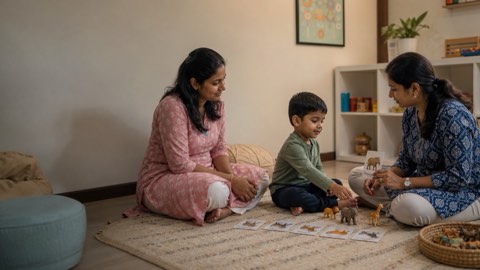
Social: real friendships appear, along with genuine sharing, turn-taking and rules in play. Imaginary friends are common and normal.
Emotional: tantrums reduce as words take over, though frustration is still large. Fears arrive — the dark, animals, monsters — as imagination develops.
School and the nap
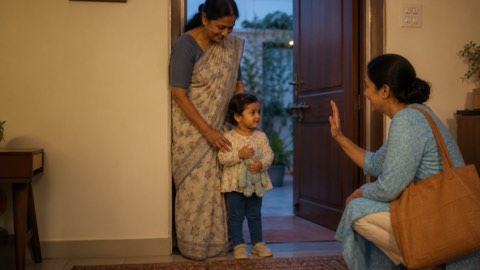
Most Indian children start playschool between two and three and a half. Look for ratios, warmth, play and outdoor time rather than worksheets — a child drilled on letters at three does not read better later, and the evidence on that is clear.
Expect a settling period of one to three weeks with crying at the gate, tiredness, and a run of colds. All normal.
The afternoon nap often ends between three and five. Replace it with quiet time rather than nothing, and expect an earlier bedtime for a few months.
Read next


Food, health and behaviour
Food: family meals, structured snacks, milk capped, and a plate that includes iron and protein daily. Involving a three-year-old in cooking measurably improves their eating.
Health: growth check and haemoglobin, deworming twice yearly, and a dental visit. This is a good age for a first eye check even without symptoms, because a child with one weak eye does not know anything is unusual.
Behaviour: consequences can now be understood and used — logical, immediate and small. Praise the effort rather than the label, and keep the number of rules small enough that you can hold every one.
Body safety: this is the age to teach the correct names for body parts, the swimsuit rule, and that secrets from parents are not allowed. Our body-safety guide has the words to use.
When to see a doctor
Same-day at any age: fast or laboured breathing, the chest sucking in, blue lips; a fit; a child who is floppy, drowsy or hard to wake; dehydration or no urine for eight hours; a rash that does not fade when pressed; repeated forceful or green vomiting; blood in stool or vomit; severe abdominal pain; or a head injury with vomiting, drowsiness or confusion. Call 108 for breathing difficulty.
At three to four specifically: speech that strangers cannot understand, not speaking in short sentences, no interest in other children, no pretend play, not running or climbing stairs, frequent falls, walking only on toes, or the loss of any skill.
And at any age, the loss of a skill a child already had needs assessment rather than a wait.
This article is general information, not medical advice, and is no substitute for personal medical advice. For any decision about your or your child's health, please consult your doctor.
Frequently asked questions
He asks 'why' fifty times a day.
That is cognitive development, not defiance. Answer the ones you can, say 'I don't know, let's find out' for the rest, and hand some back: 'what do you think?'
She has an imaginary friend.
Normal and associated with good imagination and language. Play along without making it a family joke.
Is he ready for formal writing?
Not at three. Small hands are not ready, and drawing, building, cutting and playing build the very skills writing needs later.
The nap is disappearing and evenings are terrible.
Replace it with quiet time and move bedtime earlier by thirty minutes for a few months. It settles.
Sources
Every clinical figure on this page is taken from the guidelines below. Where our numbers and your doctor's differ, ask which guideline they follow.
- WHO. WHO Child Growth Standards and Developmental Milestones (2006)Backs the motor milestones cited for ages 3–4 (pedalling, jumping, climbing, balancing on one foot, throwing and catching) and the recommendation for routine growth checks at this age.
- AAP. Caring for Your School-Age Child: Ages 5 to 12 (and related preschool guidance on HealthyChildren.org) (2023)Supports guidance on nap transition (quiet time replacing nap, earlier bedtime), age-appropriateness of formal writing at three, praise focused on effort, and the body-safety teaching points including correct anatomical names and the 'no secrets' rule.
- IAP. IAP Recommended Immunization and Preventive Care Schedule including Deworming Guidelines (2023)Supports the recommendation for twice-yearly deworming and routine haemoglobin check at the 3-year health visit.
- WHO. Guideline: Preventive chemotherapy to control soil-transmitted helminth infections in at-risk population groups (2017)Backs the twice-yearly deworming recommendation for preschool-aged children in high-burden settings such as India.
- MoHFW. National Deworming Day Programme Guidelines (2023)Supports the twice-yearly deworming advice and the inclusion of iron in the daily diet as part of anaemia-prevention guidance for children in this age group in India.
Reviewed by
- Nakul Phatak — CEO, theAsianparent India & IndonesiaHead of theAsianparent India; father of one
- Roshni Chugani — Head of Marketing, theAsianparent India & Singapore12 years in the mother-and-baby space; mother of two
Published by: theAsianparent editorial team