Your toddler at 21 months: independence, mine, and the first friendships

Everything is 'mine' at twenty-one months, and that is not selfishness — it is a child working out where they end and the world begins.
Where a 21-month-old is
Language keeps growing — often fifty to a hundred words, more two-word phrases, and the beginnings of simple questions. Naming body parts, familiar people and objects on request is usual.
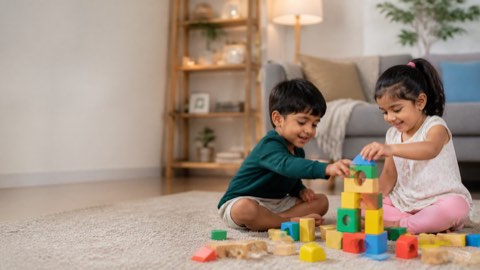
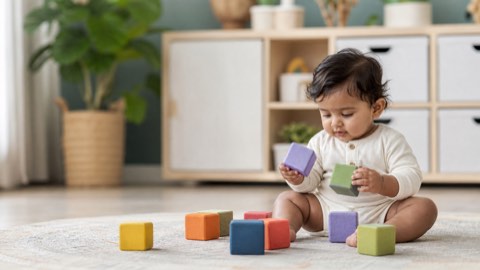
Physically: running confidently, climbing stairs both ways with support, squatting to play, and manipulating small objects with more precision — posting shapes, stacking four or five blocks.
Socially: interested in other children, playing beside rather than with them, and fiercely possessive of objects. 'Mine' is a developmental stage rather than a character flaw.
Sharing, and what to expect instead
True sharing requires understanding another person's perspective, which develops around three. Before then, expect grabbing, holding on and objecting.
What works now: duplicates of popular toys, turn-taking with a timer for older toddlers, an adult close enough to intervene early, and short play sessions before tiredness arrives.
Do not force a child to hand over a toy to stop a scene, and do not shame them for not sharing. Narrate instead: 'he wants a turn, you are still playing, he can have it next.'
Playdates of an hour, with two children rather than five, are far more successful at this age than a party.

Independence, safely
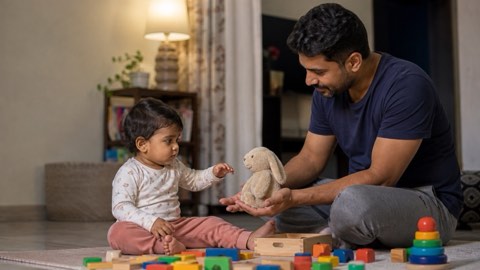
Let them do what they can: washing hands, carrying a plate, putting on shoes badly, choosing between two clothes. It is slower and it builds competence and cooperation.
Kitchen safety becomes urgent as they help: hot vessels off the floor, handles turned inward, no carrying a hot drink near a toddler, and a rule about where they stand when the stove is on.
Keep the safety rules absolute where they matter — road, balcony, water, fire, medicines — and flexible everywhere else. A child who hears no all day stops hearing it at the moment it counts.
When to see a doctor
Same-day at any age: fast or laboured breathing, the chest sucking in, blue lips; a fit; a child who is floppy, drowsy or hard to wake; no urine for six to eight hours or signs of dehydration; a rash that does not fade when pressed; repeated forceful or green vomiting; blood in stool or vomit; a swollen tender abdomen; or a head injury with vomiting or drowsiness. Call 108 for breathing difficulty.
At 21 months specifically: no two-word phrases emerging, fewer than ten words, no pointing or showing, no pretend play, no interest in other children, walking only on toes, or the loss of any skill.
And at any age, the loss of a skill a child already had — words, walking, waving, eye contact — needs an assessment rather than a wait.
This article is general information, not medical advice, and is no substitute for personal medical advice. For any decision about your or your child's health, please consult your doctor.
Frequently asked questions
She snatches from other children constantly.
Normal at this age. Shadow her during play, intervene at the flashpoint rather than after, and give the words: 'my turn', 'his turn'. It resolves with maturity rather than with lectures.
He wants to do everything himself and then rages when he cannot.
Build in extra time, break the task into a part he can do, and let him try before helping. Rushing is what causes most of these meltdowns.
Should I enrol him in a class?
Optional. Free play with other children does the same work. If a class suits your family, choose one with movement and play rather than worksheets.
How much milk should she have now?
Around 400-500 ml a day including curd. More displaces food and iron, and toddler anaemia is common in India.
Sources
Every clinical figure on this page is taken from the guidelines below. Where our numbers and your doctor's differ, ask which guideline they follow.
- WHO. WHO Child Growth Standards and developmental milestones (5–17 years); Caring for Children's Development: WHO developmental milestone resources (2006)Backs the page's developmental milestones for a 21-month-old including gross motor skills (running, climbing stairs with support), fine motor skills (stacking blocks, posting shapes), and language milestones (50–100 words, two-word phrases).
- AAP. Developmental Milestones: 2 Year Olds (2023)Supports the page's description of typical 21-month social-emotional behaviour (parallel play, possessiveness, 'mine' as a normal developmental stage) and the red-flag list including fewer than 10 words, no two-word phrases, no pointing, no pretend play, toe-walking, and regression of skills.
- WHO. Recommendations on complementary feeding: Nutrient intake values — milk intake for toddlers (2023)Supports the page's guidance that milk (including dairy sources such as curd) should be kept to approximately 400–500 ml per day in toddlers, as excessive milk displaces solid food intake and contributes to iron-deficiency anaemia.
Reviewed by
- Nakul Phatak — CEO, theAsianparent India & IndonesiaHead of theAsianparent India; father of one
- Roshni Chugani — Head of Marketing, theAsianparent India & Singapore12 years in the mother-and-baby space; mother of two
Published by: theAsianparent editorial team