Your toddler at 22 months: routines, questions and testing the rules

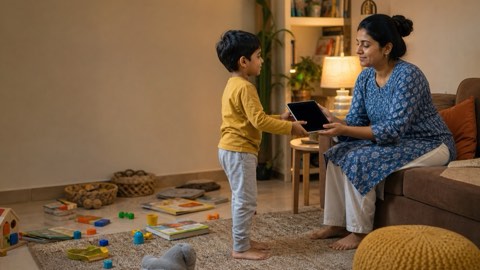
At twenty-two months a toddler knows the rules well enough to test them deliberately — and watches your face while doing it.
Where a 22-month-old is
Vocabulary expands quickly — often over a hundred words — with two- and occasionally three-word phrases, and the beginnings of 'what' and 'where' questions.
Physically: running, jumping in place, climbing confidently, kicking a ball forward, and turning single pages of a book.
Cognitively: sorting by shape and colour with help, completing simple puzzles, remembering routines and objecting when they change, and elaborate pretend play with dolls and toy vehicles.
Testing the rules
Deliberate testing — reaching for the forbidden thing while looking at you — is a cognitive milestone. They are checking whether the rule is about the object or about you watching.
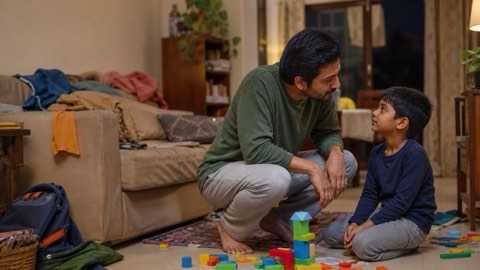
Respond the same way every time, briefly, without a lecture. Consistency is what turns a rule into background furniture rather than a daily negotiation.
In a joint family, agree the handful of rules everyone will hold. A child who is refused by the mother and granted by the grandmother learns to route around the rule rather than to follow it.
Physical punishment is worth naming here because this is the age it usually starts in Indian households. It works in the moment, increases aggression over time, and teaches the exact behaviour you are trying to stop — see our discipline guide for what to do instead.

Sleep, food and preparing for two
One nap, 11-14 hours total. Bedtime resistance and night waking often flare around now with imagination developing — a consistent routine and a night light handle most of it.
Food: family meals, milk capped, snacks structured, iron-rich food daily. Appetite still swings and that is expected.
If a second baby is coming, this is a good time to make any big transitions — a bed, a room, playschool — so they are not happening in the same fortnight as the birth. Our preparing-for-a-second-baby guide covers the timing.
When to see a doctor
Same-day at any age: fast or laboured breathing, the chest sucking in, blue lips; a fit; a child who is floppy, drowsy or hard to wake; no urine for six to eight hours or signs of dehydration; a rash that does not fade when pressed; repeated forceful or green vomiting; blood in stool or vomit; a swollen tender abdomen; or a head injury with vomiting or drowsiness. Call 108 for breathing difficulty.
At 22 months specifically: fewer than fifteen words, no two-word phrases, not following simple instructions, no pretend play, no interest in other children, or the loss of skills.
And at any age, the loss of a skill a child already had — words, walking, waving, eye contact — needs an assessment rather than a wait.
This article is general information, not medical advice, and is no substitute for personal medical advice. For any decision about your or your child's health, please consult your doctor.
Frequently asked questions
He does the thing I just said no to, while smiling at me.
That is testing, and the smile is checking your reaction. Keep the response calm, brief and identical each time; the behaviour fades when it stops being interesting.
Should I use time-out?
At this age, calm-down time with you nearby works better than isolation, which frightens young toddlers. A minute or two is plenty, and reconnecting afterwards matters more than the minutes.
Night waking has restarted.
Common now. Check the physical causes first — teeth, worms, heat, a blocked nose — then hold the bedtime routine steady and keep night responses brief and boring.
She insists on the same book every night.
Repetition is how language and story structure are learnt. Let it run; it ends by itself.
Sources
Every clinical figure on this page is taken from the guidelines below. Where our numbers and your doctor's differ, ask which guideline they follow.
- WHO. WHO guidelines on physical activity, sedentary behaviour and sleep for children under 5 years of age (2019)Backs the sleep recommendation of 11–14 hours total for toddlers in this age group, consistent with WHO's guidance for children aged 1–2 years.
- AAP. Caring for Your Baby and Young Child: Birth to Age 5 — Developmental milestones and the Bright Futures guidelines (2023)Supports the developmental milestone descriptions for 22 months — vocabulary of over 100 words, two-word phrases, running, jumping, climbing, pretend play, sorting by shape and colour, and the red-flag indicators of fewer than 15 words and no two-word phrases.
- IAP. IAP Standard Treatment Guidelines — Developmental Surveillance and Promotion (2022)Supports the developmental red flags at 22 months — fewer than 15 words, no two-word phrases, not following simple instructions, no pretend play, no interest in peers, and regression of previously acquired skills warranting prompt assessment.
- WHO. Nurturing care for early childhood development: a framework for helping children survive and thrive to transform health and human potential (2018)Supports the emphasis on consistent caregiver responses, shared family rules, and responsive caregiving as the basis for healthy social-emotional and cognitive development in toddlers.
Reviewed by
- Nakul Phatak — CEO, theAsianparent India & IndonesiaHead of theAsianparent India; father of one
- Roshni Chugani — Head of Marketing, theAsianparent India & Singapore12 years in the mother-and-baby space; mother of two
Published by: theAsianparent editorial team