How much snacking is too much?

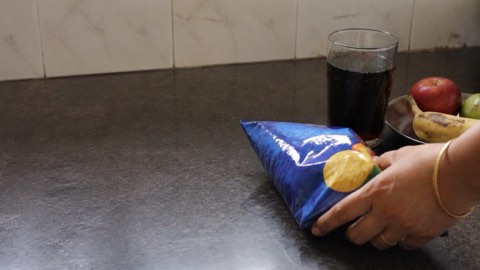
The commonest reason a child does not eat at mealtimes is that they have been eating all afternoon. Grazing is the problem that disguises itself as fussiness.
Why grazing backfires
Appetite works in cycles. A child needs to arrive at a meal genuinely hungry, and a biscuit at 11.30 removes that entirely for a 12.30 lunch.
Children who graze eat more total calories from lower-quality food, and less dal, vegetable and protein — which is where the iron and protein are.
Constant eating also means constant acid exposure for teeth. Frequency of eating matters more for decay than quantity of sugar.
And it removes the child's own hunger signals from the equation, which is the thing you actually want them to develop.
In many Indian households the pattern is reinforced by several adults each offering something, so nobody sees the total.
What a normal pattern looks like
Under one: milk on demand, plus solids offered a few times a day. Snacking as a concept does not really apply yet.
One to three years: three meals and two, at most three, planned snacks. Small stomachs genuinely need the top-ups; grazing between them does not help.
Four and up: three meals and one or two snacks, usually mid-afternoon and after school.
Roughly two to three hours between eating occasions, with nothing but water in between. This is the single most useful rule in this article.
Snacks are small meals, not treats. A snack that is a mini-meal — a paratha piece with curd, chana, a boiled egg, fruit with nuts — carries the child to the next meal. A biscuit does not.
Changing the pattern
Water only between eating times, from a cup they can reach themselves.
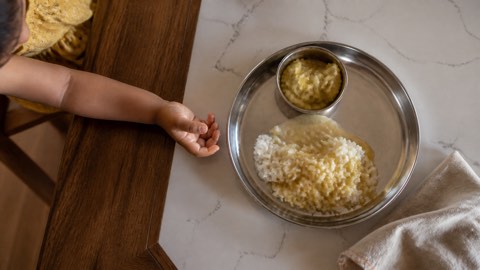
Serve snacks at the table, on a plate, at a set time — not from a packet, not walking around, not in front of a screen.
Agree it across the household. One grandparent handing out biscuits undoes the whole thing, and this needs a conversation rather than a rule stuck on the fridge.
Do not keep grazing food visible and reachable. Most toddler snacking is opportunistic.
Expect two or three difficult days. A child used to grazing will complain of hunger before the first proper meal, which is exactly the point.
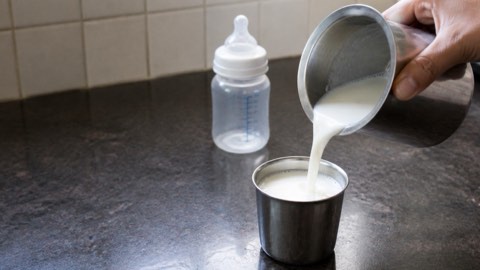
And do not replace snacks with milk. Milk between meals blunts appetite as effectively as biscuits and displaces iron.
Frequently asked questions
My child says they are hungry all the time.
Offer water, and hold to the next meal time. Genuine hunger at the table is the goal.
Isn't it better they eat something than nothing?
Not if the something removes the appetite for the meal that had the iron and protein in it.
What are good Indian snacks?
Roasted chana, boiled egg, curd, fruit with a few nuts, dhokla, idli, chilla, sprouts, makhana, peanut chikki in small amounts, and paratha pieces.
What about a child who is underweight?
Different situation: frequent calorie-dense feeding may be exactly what the paediatrician recommends. Follow their advice rather than this page.
Sources
Every clinical figure on this page is taken from the guidelines below. Where our numbers and your doctor's differ, ask which guideline they follow.
- WHO. Infant and young child feeding: Model chapter for textbooks for medical students and allied health professionals (2009)Backs the page's guidance that children under one should receive milk on demand plus solids offered a few times a day, and that snacking as a structured concept does not apply in infancy.
- IAP. IAP Guidelines on Complementary Feeding (2022)Supports the recommended meal and snack frequency for children aged one to three (three meals plus two to three planned snacks) and four and above (three meals plus one to two snacks), and the principle that snacks should be nutrient-dense mini-meals rather than low-quality treats.
- WHO. Guideline: Sugars intake for adults and children (2015)Backs the page's claim that frequency of eating (acid exposure) matters more for dental decay than total quantity of sugar consumed.
- NICE. Obesity: identification, assessment and management (CG189) (2014)Backs the page's claim that grazing leads to higher total calorie intake from lower-quality foods and undermines a child's internal hunger and satiety signalling.
- NHS. What to feed young children (2022)Supports the structured eating pattern of three meals and planned snacks for toddlers and young children, and the recommendation to serve food at the table at set times rather than as opportunistic grazing.
Reviewed by
- Nakul Phatak — CEO, theAsianparent India & IndonesiaHead of theAsianparent India; father of one
- Roshni Chugani — Head of Marketing, theAsianparent India & Singapore12 years in the mother-and-baby space; mother of two
Published by: theAsianparent editorial team