How much solid food does a baby actually need?

There is no correct number of spoons. What there is: a rough shape by age, and a principle — you decide what is offered, the baby decides how much of it is eaten.
Readiness, and the first weeks
Start at around six months. The three readiness signs together: sitting with support and holding the head steady, losing the reflex that pushes food out of the mouth, and being able to pick up food and bring it to the mouth. Age alone is not the signal, and interest in watching you eat is not either — every four-month-old does that.
The first weeks are about learning, not nutrition. Milk supplies almost everything, and a baby who takes two spoons and stops has had a successful meal.
Start with one small meal a day, at a time when the baby is alert and not ravenous. Milk first, then solids, for the first weeks — a starving baby cannot learn.
Offer a teaspoon or two initially and build up as they take it. There is no target to hit.
Iron is the reason six months matters: stores from birth begin to run down around then, which is why iron-rich first foods and, in most Indian infants, an iron supplement matter more than the quantity.
A rough shape by age
6-7 months: one to two meals a day, building from a couple of teaspoons to a few tablespoons. Milk remains the main source of nutrition.
7-9 months: two to three meals a day, roughly two to four tablespoons each, plus the beginnings of finger food. Textures move from smooth to mashed and lumpy.
9-12 months: three meals plus one or two small snacks, roughly a quarter to a half of an adult katori per meal. Finger foods at every meal. Milk still substantial but decreasing.
12 months and beyond: three meals and two snacks, family food, with milk dropping to roughly 300-500ml a day. Food becomes the main source of nutrition and milk the accompaniment.
These are averages across many babies and not a schedule to enforce. Appetite varies hugely day to day, rises before growth spurts, and collapses during illness and teething. A week is a better unit than a meal.
Responsive feeding, textures and Indian first foods
The division of responsibility: you decide what is offered, when and where. The baby decides whether and how much. Holding to that prevents most feeding battles, and pressure is consistently associated with worse eating rather than better.
Watch for fullness cues — turning away, closing the mouth, pushing the spoon, losing interest — and stop. Do not chase the last spoon, do not distract with a screen, and do not feed a walking toddler around the building. Distraction feeding puts volume in and takes learning out.
Textures on time matter as much as quantity. Move from smooth to mashed by around seven months, to lumpy and soft finger foods by eight to nine, and to chopped family food by around a year. Babies kept on purée past nine months are markedly harder to feed later.
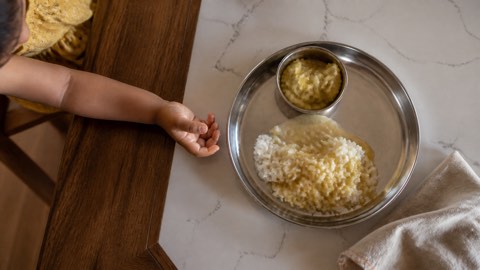
Indian first foods that work well: ragi porridge, rice and moong dal khichdi with ghee, mashed dal and rice, well-cooked mashed vegetables, curd, mashed banana, steamed apple or pear, sooji halwa without much sugar, idli mashed in dal, and finely mashed paneer.
Add fat — ghee or oil — from the start. Babies need it and Indian first foods are often too low in it.
No added salt or sugar before one year. No honey before one year. No whole nuts. Introduce allergens deliberately from six months rather than delaying them.
When to see a doctor
See a paediatrician if: weight gain has slowed or stopped, the baby is not tolerating any solids by around seven to eight months, or is still entirely on smooth purée at nine to ten months.
Also for: coughing, choking, gagging repeatedly or wet-sounding breathing during feeds, which needs a swallowing assessment; forceful vomiting; blood in stool; or a rash, swelling or vomiting shortly after a specific food.
Ask about iron and vitamin D supplementation at the six-month visit rather than assuming food is covering it. Indian paediatric guidance recommends supplementation for most infants.
Ask for a referral to a paediatric dietitian if feeding is not progressing — this exists in most Indian cities and is under-used.
This article is general information, not medical advice, has not been reviewed by a paediatric dietitian, and is no substitute for personal medical advice.
Frequently asked questions
My baby eats almost nothing.
Normal in the first weeks. Milk is doing the work. Judge by weight gain and by the week rather than by the meal.
Should I reduce milk to make them eat more?
Not in the first year without medical advice. Milk is the main source of nutrition until around twelve months.
How do I know they have had enough?
They stop, turn away, or lose interest. That is the answer, and it is more reliable than any measured portion.
Purée or baby-led weaning?
Both work and most families use a mix. What matters more is moving textures on time and letting the baby participate.
Sources
Every clinical figure on this page is taken from the guidelines below. Where our numbers and your doctor's differ, ask which guideline they follow.
- WHO. Complementary feeding: family foods for breastfed children (2000)Supports the recommendation to start solids at around six months, the principle that milk remains the main source of nutrition in the first year, and the guidance on meal frequency and portion progression by age.
- WHO. Guiding principles for complementary feeding of the breastfed child (2003)Supports the three readiness signs for starting solids, the age-based meal frequency targets (1–2 meals at 6–7 months rising to 3 meals plus snacks by 9–12 months), and the instruction to add fat from the start because energy density of first foods must be adequate.
- IAP. IAP Guidelines on Complementary Feeding (2023)Supports the recommendation that most Indian infants need an iron supplement from six months as birth stores begin to deplete, that vitamin D and iron supplementation should be discussed at the six-month visit, and that Indian paediatric guidance recommends supplementation for most infants.
Reviewed by
- Nakul Phatak — CEO, theAsianparent India & IndonesiaHead of theAsianparent India; father of one
- Roshni Chugani — Head of Marketing, theAsianparent India & Singapore12 years in the mother-and-baby space; mother of two
Published by: theAsianparent editorial team