Baby carriers and slings: choosing one, and wearing it safely

A carrier is the single most useful thing most Indian families buy — crowds, markets, stairs and a baby who only sleeps on you. Two rules make it safe.
The types
Stretchy wrap: a long cloth tied around you, best for newborns, very comfortable, and it takes practice. The traditional cloth sling used across India is a version of this and works well.
Ring sling: a shorter cloth through two rings, quick to put on, good for short carries and easy feeding, and it puts the weight on one shoulder.
Soft structured carrier: buckles and padded straps, the easiest to learn, best for longer carries and for fathers who find wraps fiddly. Look for one that adjusts small enough for a newborn or buy an infant insert.
Framed hiking carriers are for toddlers and long walks, not for babies.
The safety rules
Airway first. The baby's face must always be visible and clear of fabric and your body, chin off the chest, with room for a finger between chin and chest. A curled baby with the chin tucked down cannot breathe well, and this is the mechanism behind carrier deaths in small infants.
Position: high and tight, close enough to kiss the top of the head. A baby sagging low in a loose carrier is both unsafe and murder on your back.
Hips: the baby's knees should be higher than the bottom in an M shape, with the fabric supporting from knee to knee. Carriers that leave the legs dangling straight down from the crotch are not hip-healthy for young babies, which matters given how common hip dysplasia screening is in infancy.
Heat: in Indian summers, a carrier is an extra layer of body heat. Dress the baby lightly, check the neck for sweat, offer feeds often, and take breaks in the shade.
Never wear a baby while cooking at the stove, carrying hot drinks, riding a two-wheeler, or in a car — none of those are safe with a baby strapped to you.

Getting the most out of it
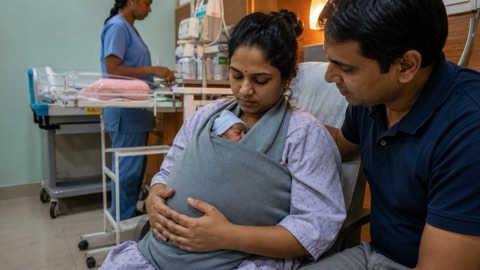
Newborns can be carried from birth in an appropriate carrier with good head and neck support, and this is exactly what kangaroo care does for preterm babies — see our premature baby guide.
Learn to put it on in front of a mirror, then over a bed for the first attempts. Get the father wearing it early; a carrier is the fastest route to a father who can settle the baby alone.
For back carries, wait until the baby has strong head and trunk control, usually after six months, and learn the technique with someone spotting you the first few times.
Wash the carrier — it will collect milk, drool and sweat — and check the buckles and seams periodically for wear.
When to see a doctor
Urgent: a baby who is limp, blue, breathing noisily or hard to rouse after being in a carrier — take them out immediately, check the airway and call 108 for any breathing difficulty.
Also worth asking about: a baby with a known hip problem or one being monitored for hip dysplasia, a preterm baby, or a baby with breathing difficulties — check with your paediatrician about which carrier and position suits.
This article is general information, not medical advice, and is no substitute for personal medical advice. For any decision about your or your child's health, please consult your doctor.
Frequently asked questions
Does carrying spoil a baby or delay walking?
Neither. Carried babies cry less and walking is not affected. What matters is that they also get plenty of floor time each day for rolling and crawling practice.
Is the traditional cloth sling safe?
Yes, when tied so the baby is high, tight and with a clear airway. Generations of Indian families have used them well; the failures come from a loose tie and a slumped baby.
Front-facing out
is it okay? — Only for older babies with strong head control, and only in short bursts. It offers less support, no hip-healthy position, and an over-stimulating view for a small baby.
My back hurts when I use it.
Usually the carrier is too loose or worn too low. Tighten the waist belt onto your hips, bring the baby higher, and adjust the shoulder straps. If it still hurts, the carrier may not fit your body.
Reviewed by
- Nakul Phatak — CEO, theAsianparent India & IndonesiaHead of theAsianparent India; father of one
- Roshni Chugani — Head of Marketing, theAsianparent India & Singapore12 years in the mother-and-baby space; mother of two
Published by: theAsianparent editorial team