Pregnancy week 6: a flicker on the screen

A tiny flickering dot on a blurry screen — week six's great gift. Meanwhile your nausea and exhaustion are climbing; that too is this week's truth.
The flickering dot
This week or next, a moment arrives in the scan room that stays for life. In a smudged grey circle a dot flickers — steadily. The doctor says: 'That's the heartbeat.'
It beats about 110 times a minute and will speed up week on week — to 160-170 by week eight. Nearly double your own.
But not everyone's scan lands this week, and no heartbeat visible in early week six is common — a one-week shift in dates is all it takes. 'Repeat in a week' is arithmetic, not bad news.
Your baby this week
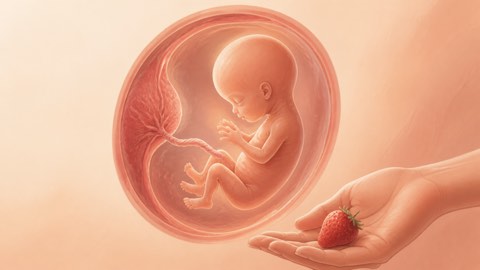
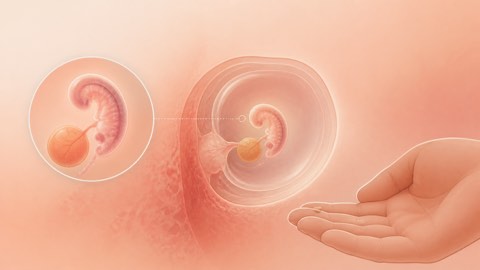
The embryo is moong-dal sized — about five millimetres — curled with a discernible head and tail; a human embryo at this age looks exactly so.
The face is beginning: two dark spots where eyes will be, two pits for ears. Arms and legs are budding as tiny paddles.
The neural tube has closed — folic acid's biggest job is done. At its head end, the brain's three sections are forming.
Read next

Changes in your body
The nausea is entering its steepest stretch — weeks six to nine are the hardest for most women. Knowing it's a climb, not a plateau, is itself relief — the descent usually starts by weeks twelve to fourteen.
Food aversions get strange — yesterday's favourite smells revolting, while tamarind and raw mango call out. Follow the body; short of poison, there are no wrong answers to a craving this month.
Constipation begins quietly too — progesterone slows the gut. More water, more fibre (dalia, fruit, greens), a light walk — that's the treatment, not laxatives.
What to do this week
The first antenatal visit happens this week or next. Carry: your last period date, the medicines list, family history (diabetes, BP, thalassaemia), and your questions written down — rooms make people forget half of them.
The first-visit test set is fairly standard: blood (haemoglobin, group, sugar, thyroid, HIV, hepatitis B, syphilis), urine, and a scan if indicated. All free at the government centre.
For heavy vomiting keep ORS or nimbu-pani-salt handy — sipping through the day holds better than glasses at once.
Manage the exhaustion, don't fight it — full nights, a twenty-minute afternoon lie-down where possible, and asking for help at home. The body is building an organ; this is that bill.
Week 6 at a glance
The week's essentials in one place. Your doctor may adjust these for your situation.
| Item | In week 6 |
|---|---|
| Main event | Heartbeat may show on scan — ~110/minute |
| Baby's size | Moong dal — about 5 mm |
| Forming | Eye and ear positions, limb buds, brain sections |
| Possible symptoms | Peak-bound nausea, aversions, constipation, exhaustion |
| Do now | First visit + baseline tests |
| Free where | All early tests at the government centre; PMSMA on the 9th |
| Keep going | Folic acid daily |
When to see a doctor at once
Bleeding with cramps, or worsening one-sided pain — same-day doctor. Week six is the commonest time for an ectopic pregnancy to declare itself, and it is only dangerous when ignored.
Vomiting that keeps nothing down, dark scanty urine, dizziness — hyperemesis; treatable, not for enduring. And fever with urinary burning is also same-day — a urine infection in pregnancy is never left alone.
This article is general information only and no substitute for personal medical advice. The person who can advise you knowing your health, your medicines and your previous pregnancies is your obstetrician, or the doctor at your nearest health centre.
Work out your due date
Enter the first day of your last period and your cycle length — your estimated due date, this week's count and the anomaly scan window all appear right here.
It is only an estimate — most babies aren't born on the exact date. A first-trimester scan dates a pregnancy more accurately; in the end, your doctor's date is the one that counts.
Frequently asked questions
No heartbeat on the scan
is it over? — Not necessarily. Early in week six it's often simply too soon — ovulate a week late and the embryo is a week smaller. That's why the repeat in seven-ten days.
What should the heart rate be?
Around 100-120 at week six, rising to 160-170 by week eight. Faster than yours — and that's correct.
What do I eat through the nausea?
Whatever stays down. Dry and plain works best — biscuits, murmura, toast, banana, curd rice. If hot food's smell is the trigger, eat it cooled.
Is sex safe?
In a normal pregnancy, yes, throughout. If there's been bleeding, a history of miscarriage, or your doctor has said no — their word is the rule.
Sources
Every clinical figure on this page is taken from the guidelines below. Where our numbers and your doctor's differ, ask which guideline they follow.
- WHO. WHO recommendations on antenatal care for a positive pregnancy experienceBacks the page's description of the standard first-visit antenatal test set (haemoglobin, blood group, blood sugar, HIV, syphilis, hepatitis B, urine) and the general framework for early antenatal care visits.
- MoHFW. Pradhan Mantri Surakshit Matritva Abhiyan (PMSMA) – Antenatal Care PackageSupports the claim that the first-visit blood and urine investigations are available free at government centres in India, and that thyroid testing is included in the standard first-trimester screen.
- NICE. Antenatal care (NG201)Supports the advice on managing nausea with plain/dry foods and oral rehydration, the recommendation not to use laxatives as first-line treatment for pregnancy constipation (instead dietary fibre and fluids), and the guidance to report heavy vomiting that keeps nothing down as hyperemesis requiring treatment.
- NICE. Ectopic pregnancy and miscarriage: diagnosis and initial management (NG126)Backs the page's advice that bleeding with cramps or worsening one-sided pain at week six warrants same-day assessment due to the risk of ectopic pregnancy, and that an absent heartbeat at early week six alone is not conclusive — a repeat scan in 7–10 days is appropriate.
- IAP. IAP Standard Treatment Guidelines – Hyperemesis Gravidarum and Nausea/Vomiting in PregnancySupports the claim that weeks six to nine represent the peak period of nausea, that symptoms typically improve by weeks twelve to fourteen, and that hyperemesis (vomiting that keeps nothing down, dark scanty urine, dizziness) is a treatable condition requiring prompt medical attention rather than home endurance.
Reviewed by
- Nakul Phatak — CEO, theAsianparent India & IndonesiaHead of theAsianparent India; father of one
- Roshni Chugani — Head of Marketing, theAsianparent India & Singapore12 years in the mother-and-baby space; mother of two
Published by: theAsianparent editorial team