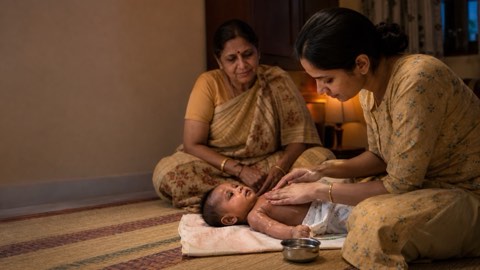
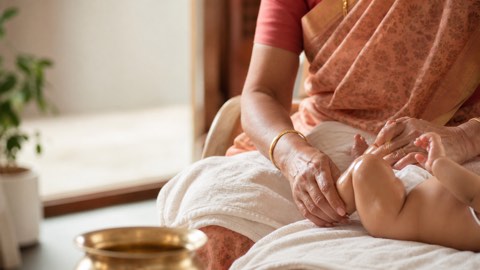
Eyes, ears and nose: the safe way to clean a baby, and what to never put in

Three parts of a baby that families traditionally clean the most and that actually need the least. Here is the safe routine — and the short list of things that should never go in.
Eyes
Cleaning is simple: a cotton ball or soft cloth moistened with plain clean water, wiped once from the inner corner outward, a fresh swab for the other eye. Once a day and whenever crusted. That is the entire routine.
Sticky or watery eyes in the early months are common and usually a blocked tear duct — the tiny drainage channel has not opened yet. Most clear by the first birthday. Your doctor may show you a gentle massage over the inner corner; do that rather than home remedies, and clean the discharge away as above.
Never put kajal, surma, breastmilk, honey, rosewater or any oil in a baby's eyes. Kajal is the big one: it is applied to nearly every Indian newborn, many preparations still contain lead, and it causes irritation, watering and infection. The nazar mark, if the family wants one, belongs on the cheek or behind the ear.
Ears
Clean only what you can see: wipe the outer ear and behind it with a damp cloth. Nothing goes inside the ear canal — no cotton buds, no cloth-wrapped fingers, no ear candles. Wax is protective, moves out by itself, and pushing at it causes impaction and injury.
No oil in the ears. Warm oil is a traditional standby for babies and for ear pain, and it is not recommended: it can cause infection, and if the eardrum happens to be perforated it does real harm. Ear pain gets a doctor, not a bottle of oil.
Watch for hearing: newborns should startle at loud sounds, and by three to four months turn toward voices. India runs newborn hearing screening in many hospitals — if it was not done, or if your baby does not respond to sound, ask for a test rather than waiting to see.

Nose
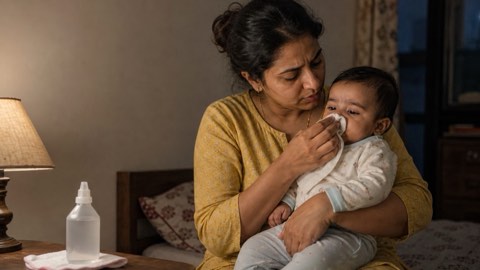
Babies breathe mainly through the nose, so a blocked one interferes with feeding and sleep. The safe tool is saline drops: two drops in each nostril, wait a moment, then gently suction with a bulb syringe if the baby is really congested, or simply let the baby sneeze it out — which they will.
Nothing else goes in. No oil drops, no cotton buds pushed inside, no breastmilk instilled, no adult decongestant drops. Vapour rubs and balms are not for babies' noses — check the label age, and never apply near a small baby's nostrils.
A little steam humidity in the room helps a congested baby, but keep the baby far from hot water containers. Feeding little and often works better than fighting a blocked nose through one long feed.
When to see a doctor
Eyes, same-day: redness of the white of the eye with swelling of the lids, thick pus, eyes glued shut repeatedly, sensitivity to light, cloudiness of the black of the eye, an eye injury, a white reflection in photographs instead of red-eye, or any eye problem in a baby under one month.
Ears, same-day: ear pain (a baby will pull at the ear, cry inconsolably, and often have fever), any discharge or blood from the ear, swelling or redness behind the ear, or hearing that seems suddenly reduced after an illness. Never treat suspected ear infection at home — it needs an examination.
Nose, same-day: any breathing difficulty, a foreign object pushed up a nostril (very common in toddlers — do not try to dig it out yourself), a nosebleed that will not stop with ten minutes of pinching, or a persistent one-sided smelly discharge, which usually means something is in there.
This article is general information, not medical advice, and is no substitute for personal medical advice. For any decision about your or your child's health, please consult your doctor.
Frequently asked questions
My family insists kajal keeps the eyes healthy and large
how do I refuse politely? — Give them the medical version: 'the doctor said no kajal in the eyes, it causes infection and some brands have lead.' Then offer the compromise everyone accepts: a small mark behind the ear or on the sole of the foot. The tradition's purpose is protection; this version protects the eyes too.
Is breastmilk really good for eye and ear infections?
No. It is a popular remedy and it delays proper treatment. Breastmilk is the perfect food, not an eye drop; infections need the right medicine and an examination first.
How do I clean the folds behind the ears and under the neck?
Damp cloth, then dry thoroughly — that is where sweat and milk collect and where rash begins. Do it at every bath and check daily in hot weather.
The baby's eyes look crossed. Should I worry?
In the first three to four months, intermittent crossing is normal as eye muscles coordinate. Beyond four months, constant crossing, one eye drifting, or a head tilt to see needs an eye specialist — early treatment of squint and lazy eye works far better than late treatment.
Sources
Every clinical figure on this page is taken from the guidelines below. Where our numbers and your doctor's differ, ask which guideline they follow.
- WHO. Recommendations on newborn health: Guidelines approved by the WHO Guidelines Review Committee (2017)Backs the general newborn care approach including keeping the eyes clean with water and the recommendation to seek same-day care for newborn eye problems such as thick discharge or swollen lids.
- NICE. Otitis media (acute): antimicrobial prescribing (NG91) (2018)Supports the recommendation that suspected ear infection in babies requires medical examination and should not be treated at home, consistent with the page's same-day care guidance for ear pain, fever, and discharge.
- NHS. Newborn hearing screening (2023)Supports the recommendation that newborns should receive hearing screening and that parents should seek a test if screening was missed or if the baby does not respond to sound.
Reviewed by
- Nakul Phatak — CEO, theAsianparent India & IndonesiaHead of theAsianparent India; father of one
- Roshni Chugani — Head of Marketing, theAsianparent India & Singapore12 years in the mother-and-baby space; mother of two
Published by: theAsianparent editorial team