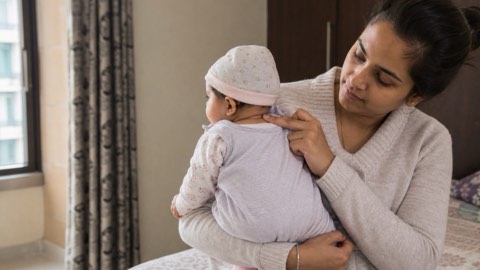
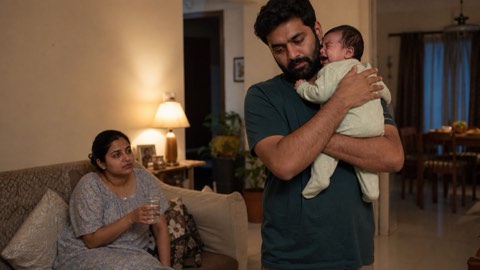
Dressing a newborn for Indian weather, and using AC safely

The instinct in almost every Indian household is to add a layer. Overheating is more common and more dangerous than being slightly cool, and the check takes two seconds.
The rule, and the check
One more layer than you are comfortable in. That is the whole rule, and a swaddle or wrap counts as a layer.
Check the chest or the back of the neck with the back of your hand. Warm and dry is right. Do not judge by the hands and feet — a newborn's extremities are normally cool, and warming them is why most Indian babies end up over-dressed.
Signs of overheating: sweating, damp hair, flushed skin, a hot chest, rapid breathing, and unusual sleepiness or irritability. Overheating is associated with an increased risk of sudden infant death, which is why this matters more than being slightly cool.
Signs of being too cold: a cold chest or back of the neck, and a baby who is difficult to rouse. A cold newborn is also a medical concern rather than just a comfort one.
A cap indoors is almost never needed after the first day or two. Babies lose heat through the head, which is precisely why covering it indoors contributes to overheating.
Cotton, loose, and nothing with strings, hoods or ties near the neck.
By season
Summer, most of India: a single layer of loose cotton, often just a jhabla and a nappy. Indoors in real heat, a nappy and a thin cotton cloth is enough. Keep out of direct sun entirely — sunscreen is not recommended under six months, so the answer is shade, timing and clothing.
Feed more often in the heat rather than giving water. Under six months, no water at all, however hot it is.
Monsoon: the problem is damp rather than cold. Keep the baby dry, change out of damp clothes promptly, watch skin folds for rashes, and do not over-layer because the air feels cool — humidity makes over-wrapping worse.
Winter in the north: layers rather than one thick garment, so you can remove one. A cap and socks outdoors, removed indoors and in the car. Avoid thick synthetic quilts near a sleeping baby entirely.
Bulky winter clothing must come off before a car seat — a thick jacket compresses under the harness and leaves it dangerously loose. Strap the baby in first, then put the blanket over.
South and coastal: light cotton nearly all year, with attention to humidity and skin folds rather than cold.
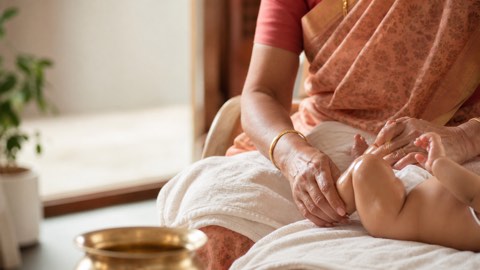

AC, fans and heaters
Air conditioning is safe for a newborn and is often the better choice in an Indian summer. Overheating is the greater risk.
Set it as close to 24C as the room allows — the same band as the safe-sleep guidance. Keep the cot out of the direct airflow, and dress the baby in one light layer; usually a full-sleeved cotton suit is enough in AC.
AC dries the air, which can dry a baby's skin and nose. A bowl of water in the room helps, as does moisturising after a bath, and saline nasal drops if the nose seems blocked.
Do not move a baby repeatedly between a very cold room and outdoor heat. Switch the AC off a little before going out, or let the room warm first.
Fans are fine. Keep the air moving in the room rather than blowing directly on the baby, and keep the cot away from the direct draught.
Room heaters in winter: never in a closed unventilated room. Coal or gas heating in a sealed room causes carbon monoxide deaths in India every winter. Keep an electric heater well away from the cot and bedding, and keep some ventilation.
AC and fans do not cause colds. Viruses cause colds, and they mostly come from visitors.
When to see a doctor
Call 108 or go to the nearest hospital immediately if your baby: is breathing fast, grunting, or drawing in beneath the ribs; has blue or grey lips, tongue or face; is floppy, unresponsive or very difficult to wake; has a fit; has a temperature of 38C or above at under three months; is not feeding at all; or has a rash that does not fade when pressed with a glass.
See a doctor for: a baby who feels unusually cold and is hard to warm, is unusually sleepy, is feeding poorly, or has a temperature of 38C or above under three months — which is an emergency at that age.
Also for: heat rash that is widespread or infected, dehydration signs — fewer wet nappies, dark urine, dry mouth, sunken eyes — or a rash in skin folds that is raw or not improving.
And urgently for any suspicion of carbon monoxide exposure: headache, drowsiness, vomiting or confusion in anyone in a room with a burning heater. Get everyone into fresh air and call 108.
This article is general information, not medical advice, and has not been reviewed by a paediatrician. It is no substitute for personal medical advice.
Frequently asked questions
My mother-in-law says the baby must be covered and capped at all times.
Overheating is a real risk and being slightly cool is not. Check the chest, and use that rather than an argument.
Is AC safe for a newborn?
Yes, set as close to 24C as the room allows and out of the direct draught. It is safer than an overheated room.
Can I use sunscreen on a newborn?
Not under six months. Use shade, timing and clothing instead.
Does the baby need socks and mittens indoors?
Usually not. Cool hands and feet are normal and are not a reason to add layers.
Sources
Every clinical figure on this page is taken from the guidelines below. Where our numbers and your doctor's differ, ask which guideline they follow.
- WHO. Recommendations on newborn health: Guidelines approved by the WHO Guidelines Review Committee (2017)Backs the claim that keeping a newborn warm (not hot) is essential, that cool extremities are normal, and that temperature regulation guidance applies in the newborn period.
- NHS. Reducing the risk of sudden infant death syndrome (SIDS) (2023)Backs the overheating–SIDS link, the 'one more layer than you' dressing rule, the recommendation to check the chest/back of neck rather than hands and feet, and the guidance that room temperature around 16–20°C (consistent with the 24°C AC guidance as an upper comfort band) is appropriate.
- WHO. Infant and young child feeding: Model Chapter for textbooks (2009)Backs the claim that babies under six months should not be given water even in hot weather, and that more frequent breastfeeding is the correct response to heat.
- AAP. Sun Safety: Information for Parents About Sunburn and Sunscreen (2023)Backs the claim that sunscreen is not recommended for babies under six months, and that shade, timing and protective clothing are the correct alternatives.
Reviewed by
- Nakul Phatak — CEO, theAsianparent India & IndonesiaHead of theAsianparent India; father of one
- Roshni Chugani — Head of Marketing, theAsianparent India & Singapore12 years in the mother-and-baby space; mother of two
Published by: theAsianparent editorial team