Reducing the risk of sudden infant death: swaddling, temperature and the room

Most of what reduces this risk is about the surface, the temperature and the position. Swaddling helps some babies and becomes dangerous at a specific point.
What reduces the risk
On the back, for every sleep, day and night, until the baby can roll both ways reliably. Not the side, which is unstable, and not the tummy. This single change is responsible for the largest fall in sudden infant deaths anywhere it has been adopted.
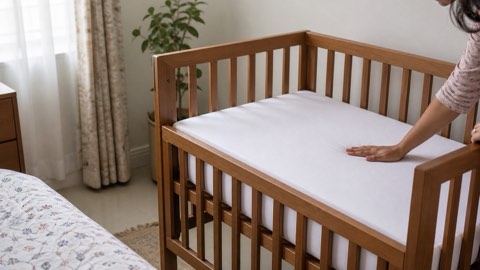
A firm, flat, separate surface. No pillow, no quilt, no bumpers, no soft toys, no positioners or wedges. Nothing in the space but the baby and a fitted sheet.
Feet to the foot of the cot, so the baby cannot slide down under a covering. If you use a blanket, tuck it in no higher than the shoulders.
Room-sharing without bed-sharing for the first six months. The baby in their own cot, cradle or jhula, in the parents' room, is associated with lower risk.
A smoke-free home and car, including during pregnancy. This is one of the strongest modifiable factors and it applies to everyone in the household.
Breastfeeding, where it is possible, is associated with lower risk. So is a soother at sleep after breastfeeding is established, for parents who choose to use one.
Never sleeping with a baby on a sofa or an armchair. This is far more dangerous than a bed and it is exactly what exhausted parents do at 4 a.m.
And never leaving a baby to sleep unsupervised in a car seat, bouncer, swing or jhula — the semi-upright position can let a newborn's head fall forward and obstruct the airway.
Swaddling, safely
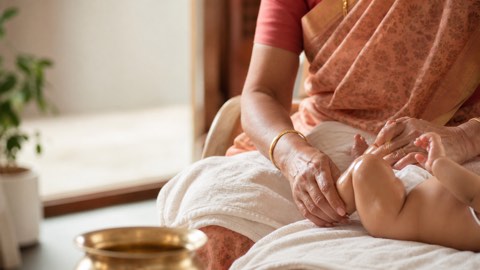
Swaddling settles many newborns by containing the startle reflex. It is not necessary, and if you do it, the details matter.
Stop swaddling at the first sign of rolling, usually somewhere around three to four months — and often earlier. A swaddled baby who rolls onto their front cannot push up or turn their head, and this is the specific danger.
Arms can be swaddled in the early weeks; many families move to arms-out once the startle settles.
Never over the head or face, and never so the baby's face can be covered by loose fabric.
Hips must be loose. The legs need to bend up and out — tight straight swaddling of the legs, which is traditional in many Indian households, is associated with hip dysplasia.
Not too tight across the chest: you should be able to slide a flat hand between the cloth and the baby's chest.
A swaddled baby always sleeps on their back, and needs one fewer layer than an unswaddled one because the cloth is itself a layer.
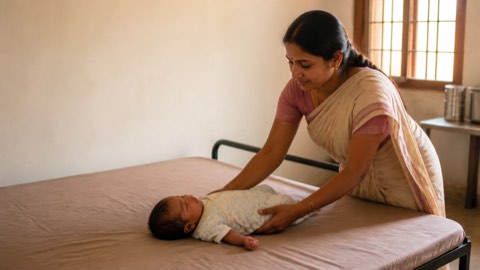
Temperature, and the Indian room
Overheating raises the risk, and Indian homes err heavily towards over-wrapping. The traditional instinct to cover a newborn thoroughly, even in a warm room, is the commonest problem here.
Aim for a comfortably cool room — roughly 20 to 24C is the usual guidance. In much of India for much of the year that means a fan or air conditioning rather than more layers.
The rule of thumb: one more layer than an adult is comfortable in, and that includes the swaddle as a layer. A cap indoors is almost never needed after the first day or two, and a covered head is a significant contributor to overheating.
Check the chest or the back of the neck, not the hands and feet. A newborn's hands and feet are normally cool, and warming them is the reason most babies get over-dressed.
Signs of overheating: sweating, damp hair, flushed skin, rapid breathing, and a hot chest.
Air conditioning is safe for a newborn and is often the better option: set it as close to 24C as the room allows, keep the baby out of the direct airflow, and dress them in one light layer. The same applies to a fan — air moving in the room rather than directly onto the baby.
Do not use a room heater in a closed room without ventilation. Coal or gas heating in an unventilated room is a carbon monoxide risk and causes deaths in India every winter.
When to see a doctor
Call 108 or go to the nearest hospital immediately if your baby: is breathing fast, grunting, or drawing in beneath the ribs; has blue or grey lips, tongue or face; is floppy, unresponsive or very difficult to wake; has a fit; has a temperature of 38C or above at under three months; is not feeding at all; or has a rash that does not fade when pressed with a glass.
About the checking: many parents check breathing repeatedly through the night, and that is normal in the early weeks. A quiet hand on the chest is enough — you do not need to wake the baby, and you do not need a monitor.
Home breathing and heart-rate monitors marketed for sudden infant death have not been shown to reduce it, and they generate frequent false alarms. They are not recommended as a safety measure and they are not a substitute for safe sleep practices.
See a doctor for: pauses in breathing, noisy or grunting breathing, a baby who is persistently sweaty during feeds, or any episode where the baby went limp, blue or unresponsive — even if they recovered completely.
This article is general information, not medical advice, and has not been reviewed by a paediatrician. It is no substitute for personal medical advice.
Frequently asked questions
My baby rolls onto their front in the night.
Once a baby can roll both ways reliably, you do not need to turn them back. Keep starting them on their back, and stop swaddling before rolling begins.
Is a jhula safe for sleep?
For supervised settling, yes. Babies should not be left to sleep unsupervised in a jhula, swing or car seat.
Is AC bad for a newborn?
No. Overheating is the greater risk in most of India. Keep the baby out of the direct draught and dress lightly.
Do I need a breathing monitor?
No. They have not been shown to reduce risk and they cause a great deal of false alarm. Safe sleep practices are what work.
Sources
Every clinical figure on this page is taken from the guidelines below. Where our numbers and your doctor's differ, ask which guideline they follow.
- NHS. Reduce the risk of sudden infant death syndrome (SIDS)Backs the back-sleep position for every sleep, feet-to-foot-of-cot positioning, firm flat separate surface with no soft bedding, room-sharing without bed-sharing for the first six months, smoke-free environment, breastfeeding association with lower SIDS risk, soother use after breastfeeding is established, and the danger of sleeping on a sofa or armchair.
- NICE. Postnatal care (NG194)Backs guidance on safe infant sleep environment, room-sharing, avoiding bed-sharing, and advice on overheating as a modifiable SIDS risk factor.
- WHO. WHO recommendations on maternal and newborn care for a positive postnatal experienceBacks breastfeeding as associated with lower infant mortality risk and the importance of a smoke-free environment for newborn safety.
- WHO. Recommendations for care of the preterm or low-birth-weight infant / SIDS risk-reduction advice (Global)Backs the back sleep position, avoidance of over-wrapping and overheating in newborns, and breastfeeding as a protective factor.
- AAP. Swaddling: Is it Safe? (HealthyChildren.org)Backs stopping swaddling at the first sign of rolling, keeping hips loose with legs able to bend up and out to avoid hip dysplasia, never covering the face, ensuring a hand can slide between cloth and chest, and that a swaddled baby must always sleep on their back.
- IAP. IAP Guidelines on Safe Sleep for InfantsBacks the back sleep position for Indian infants, avoidance of soft bedding, room-sharing in the parents' room, caution against over-bundling in warm Indian climates, and avoidance of unsupervised sleep in car seats, bouncers or swings.
Reviewed by
- Nakul Phatak — CEO, theAsianparent India & IndonesiaHead of theAsianparent India; father of one
- Roshni Chugani — Head of Marketing, theAsianparent India & Singapore12 years in the mother-and-baby space; mother of two
Published by: theAsianparent editorial team