Ear infections in children: spotting them, treating them, and the hearing question

A child who wakes screaming and pulls at one ear is a scene most Indian parents recognise. Here is what is happening and what actually helps.
Recognising it
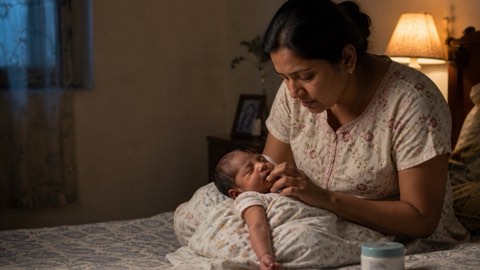
In an older child: ear pain, often worse lying down, sometimes with fever, and reduced hearing on that side. In a baby or toddler, who cannot say where it hurts: inconsolable crying, waking at night, pulling or rubbing an ear, fever, poor feeding, and irritability — usually a few days into a cold.
Most ear infections follow a cold, because the tube connecting the middle ear to the throat is short and horizontal in small children and blocks easily. This is why toddlers get them and adults mostly do not.
Discharge from the ear usually means the eardrum has perforated, which relieves the pain suddenly. It sounds alarming and usually heals — but it needs a doctor.
Treatment
Pain relief first: paracetamol or ibuprofen at the weight-correct dose, which works better for ear pain than most parents expect. A warm compress helps.
Antibiotics are not automatic. Many ear infections are viral or settle on their own, so doctors often use a watch-and-wait approach for 48 hours in older children who are not very unwell — with antibiotics for babies under two, severe pain, high fever, both ears affected, or discharge.
If antibiotics are prescribed, finish the course. Half-finished courses are a major driver of resistance and of infections that come back.
What not to do: no oil, no garlic juice, no breastmilk, no warm liquids poured into the ear. These are common Indian household remedies, they do not treat the infection, and if the eardrum is perforated they can cause real harm. Nothing goes into the ear canal, including cotton buds.
Glue ear and hearing
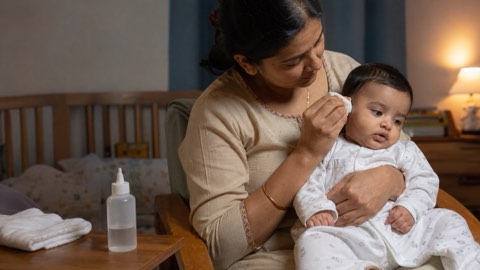
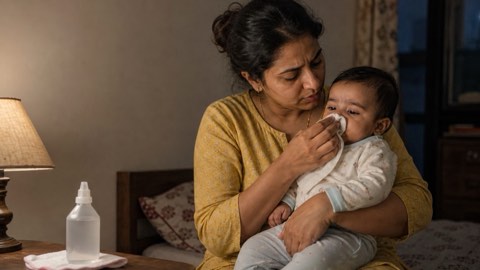
After an infection, fluid can stay behind the eardrum for weeks — glue ear. It is not painful, and it muffles hearing, which is why it matters: a child who cannot hear well for months during the language-learning years can fall behind in speech.
Signs: turning up the television, not responding when called, saying 'what' repeatedly, speech that is unclear or has stopped progressing, inattention at school, or balance problems.
Most glue ear resolves within three months. Persistent cases are assessed with a hearing test, and grommets (small tubes) are used where hearing is affected for long enough.
Ask for a hearing test if your child has had repeated ear infections, if speech is delayed, or if you have any suspicion at all that hearing is not normal. Do not wait to see.
When to see a doctor
Emergency: swelling, redness or tenderness of the bone behind the ear, a child pushed forward or with the ear sticking out, a stiff neck, severe headache, drowsiness, confusion, a fit, or facial weakness. Call 108.
Same-day: ear pain in a child under two, any ear discharge, high fever with ear pain, severe pain, pain in both ears, a child who is very unwell, or pain that has not improved after 48 hours of pain relief.
Book an appointment for: repeated ear infections, suspected hearing loss, delayed speech, or persistent muffled hearing after an infection.
This article is general information, not medical advice, and is no substitute for personal medical advice. For any decision about your or your child's health, please consult your doctor.
Frequently asked questions
Can bathing or head washing cause ear infections?
Not in a child with intact eardrums; water in the outer ear does not reach the middle ear. Colds cause them. A child with grommets or a perforation does need to keep water out — ask the doctor.
Should I use ear drops?
Only prescribed ones. Antibiotic drops are used for outer-ear infections and for discharge in some cases, and are not a substitute for oral antibiotics in a middle-ear infection.
My child gets an ear infection with every cold.
Worth an ENT opinion. Repeated infections may need investigation for adenoid enlargement, allergy or glue ear, and a hearing test either way.
Is it linked to bottle feeding?
Feeding a baby lying flat with a propped bottle does increase the risk. Feed semi-upright and never prop the bottle.
Sources
Every clinical figure on this page is taken from the guidelines below. Where our numbers and your doctor's differ, ask which guideline they follow.
- WHO. Ear and hearing care: prevention and management (2021)Backs the claim that untreated or recurrent middle-ear infections and associated hearing loss during early childhood can delay speech and language development.
- NICE. Otitis media (acute): antimicrobial prescribing (NG91) (2018)Backs the watch-and-wait approach for 48 hours in older children who are not severely unwell, and the criteria for immediate antibiotics (children under two, bilateral infection, discharge, severe pain, high fever), as well as paracetamol or ibuprofen for pain relief.
- NICE. Otitis media with effusion in under 12s: surgery (NG105) (2023)Backs the description of glue ear (fluid behind the eardrum after infection), its typical resolution within three months, the use of a hearing test for persistent cases, and insertion of grommets where hearing is significantly affected.
- NHS. Middle ear infection (otitis media) (2023)Backs the symptom descriptions (ear pain worse lying down, fever, discharge indicating perforation, inconsolable crying and ear-pulling in babies), the warning against inserting anything into the ear canal, and the same-day and emergency referral criteria including mastoid swelling, stiff neck, and facial weakness.
Reviewed by
- Nakul Phatak — CEO, theAsianparent India & IndonesiaHead of theAsianparent India; father of one
- Roshni Chugani — Head of Marketing, theAsianparent India & Singapore12 years in the mother-and-baby space; mother of two
Published by: theAsianparent editorial team