Why daily hair washing is wrong for most Indian children

Sweat, dust and a hot climate push Indian families toward daily shampooing, and daily shampooing is what leaves the hair dry, frizzy and worse. Here is the balance.
What daily shampooing does
Shampoo removes oil — that is its job. The scalp's own oil is what keeps hair flexible and the scalp barrier intact, and stripping it daily leaves hair dry and brittle while the scalp, in some children, produces more oil to compensate.
For thick, wavy or curly hair, which is most Indian hair, daily washing produces exactly the frizz, tangling and breakage families then treat with more product.
The exception is genuine dirt: a child who has been playing in dust, sweating heavily through the day, or swimming in a chlorinated pool needs rinsing — which is not the same as shampooing.
How often, by age and hair type
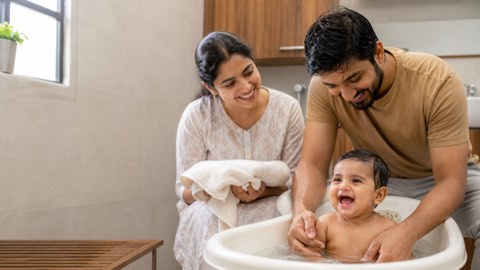
Babies: once or twice a week is plenty, with plain water or a drop of mild baby wash. Newborn hair needs almost nothing.
Toddlers and young children with straight or fine hair: two or three times a week in normal weather, more in a hot sweaty month.
Thick, wavy or curly hair: once or twice a week, always with conditioner, detangled while wet.
Teenagers: oilier scalps arrive with puberty, and every second day is reasonable — with a gentle shampoo on the scalp only and conditioner on the lengths.
In between washes, rinse with plain water after sport or a sweaty day. Water alone removes sweat and most dust without stripping oil.
Doing it well
Shampoo the scalp, not the lengths — the suds running down are enough for the hair itself. Use a small amount, massage with fingertips rather than nails, and rinse thoroughly; leftover shampoo is a common cause of itching.
Condition the lengths every wash for anything other than fine straight hair, and detangle at that point, with a wide-toothed comb, while the conditioner is still in.
Dry gently: squeeze with a soft towel or an old cotton t-shirt rather than rubbing, and let hair air-dry where possible. Regular blow-drying and any heat styling is unnecessary for children.
Never send a child to bed with wet hair tied up, and dry the scalp properly in the monsoon — damp scalps under long hair are where fungal problems start.
Dandruff, and when to see a doctor
Flaking in children is common and is usually seborrhoeic dermatitis or simple dryness. An anti-dandruff shampoo used twice a week, left on for a few minutes before rinsing, handles most of it — ask the doctor which one for a young child rather than using an adult formulation.
Oiling heavily and leaving it in for days makes dandruff worse rather than better, which is the opposite of the usual family advice.
See a doctor for: round scaly patches with broken hairs or bald spots (a fungal infection needs oral medicine, not shampoo), a red weeping or crusted scalp, severe itching that disturbs sleep, sudden hair loss, or dandruff that does not settle after a few weeks of treatment.
And check for lice before treating 'dandruff' that itches — nits stick to the hair shaft while dandruff flakes fall off, and the treatments are completely different.
Frequently asked questions
My child sweats a lot at school in summer. Isn't daily washing necessary?
Rinse with plain water daily and shampoo two or three times a week. That removes the sweat without stripping the hair.
Can I use my own shampoo on my child?
For older children, a mild adult shampoo is usually fine. For babies and toddlers, use a tear-free baby wash; adult products are harsher and sting.
Does washing hair on certain days cause colds?
No. Viruses cause colds. Wash whenever it suits your routine, and dry the hair properly afterwards in cold weather.
How do I stop the screaming during hair washing?
Tilt the head back rather than forward so water runs away from the face, use a shampoo shield or a folded flannel over the eyes, let the child hold a dry cloth, and keep it under two minutes. Most hair-wash fear is water in the eyes, and it is entirely fixable.
Sources
Every clinical figure on this page is taken from the guidelines below. Where our numbers and your doctor's differ, ask which guideline they follow.
- WHO. WHO recommendations on newborn health: Guidelines approved by the WHO Guidelines Review Committee (2017)Backs the page's guidance that newborn hair needs almost nothing and that plain water or minimal mild wash is appropriate for newborns.
- AAP. Bathing Your Baby (HealthyChildren.org) (2022)Supports the claim that once or twice a week bathing with mild baby wash is sufficient for infants and that daily washing is unnecessary for babies.
- NHS. Ringworm and other fungal infections (2023)Supports the page's warning that round scaly patches with broken hairs or bald spots indicate a fungal infection requiring oral medication rather than shampoo alone.
Reviewed by
- Nakul Phatak — CEO, theAsianparent India & IndonesiaHead of theAsianparent India; father of one
- Roshni Chugani — Head of Marketing, theAsianparent India & Singapore12 years in the mother-and-baby space; mother of two
Published by: theAsianparent editorial team