Bathing a baby: how often, how to do it safely, and the winter question

A baby's bath is the household's favourite ritual and a first-time parent's most nervous ten minutes. Here is the safe routine, the honest frequency answer, and the rules that never bend.
How often is enough
For a newborn, two or three baths a week is plenty in cool weather. Daily is fine in the Indian heat, and most families do it — the risk of daily bathing is only dryness, which the post-bath oil or lotion handles.
Until the cord stump falls off (usually one to two weeks), keep to sponge baths: a soft damp cloth over the body, section by section, keeping the stump dry and exposed. No dunking in a tub until it has healed.
On the days between baths, the essentials are a face wipe, hands, the neck folds (where milk collects), and a proper clean at every nappy change. That is genuinely all a newborn needs.
The safe routine, step by step
Set up first, before the baby is undressed: everything within arm's reach — towel, clean clothes, nappy, cleanser, a mug, and the bath. Fill the tub with about five to eight centimetres of water. Test the temperature with your elbow or inner wrist: comfortably warm, never hot. Around 37°C is the aim; if it feels warm on your wrist, it is right.
Room warm and draught-free, fan off, door closed. Undress the baby, keeping a towel over the body for warmth. Support the head and neck with one forearm and hold the far shoulder with that hand — that grip leaves your other hand free and keeps the face clear of water at all times.
Wash from cleanest to dirtiest: face with plain water and cotton (each eye wiped inward-to-outward with a separate swab), then head, then body, folds carefully, nappy area last. Mild baby cleanser or none. Five to ten minutes total — babies chill fast.
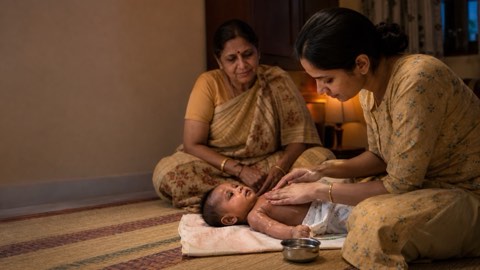
Lift out with both hands, wrap immediately, pat dry with special attention to the neck, armpits, groin and behind the knees. Then moisturise or oil, dress, feed. Many families put the massage before the bath and the feed after — that sequence works beautifully and often buys a long nap.
The rules that never bend
Never leave a baby alone in or near water, not for a second, not to answer the door or take a call. Babies can drown in a few centimetres of water and in silence. If you must go, take the baby with you, wrapped in the towel.
Never add hot water while the baby is in the tub. Fill and mix first, cold water in first then hot, and test again before the baby goes in. Geysers and bucket-and-mug bathing are exactly where scalds happen — check every mug.
No swimming aids, bath seats or neck floats as a substitute for hands. Neck rings for baby 'swimming' in particular have caused injuries and are not recommended by paediatricians.
Winter, weather and the family debate
Cold weather does not require stopping baths — it requires warming the room, working quickly, and drying thoroughly. A cold, damp baby is the risk; a clean baby is not. Two to three baths a week in a winter month, with daily face-hands-nappy cleaning, is perfectly reasonable.
The old rule against bathing the mother or baby for many days after birth was about avoiding chills and infection in an era before warm bathrooms and clean water. Its modern version is simply: warm room, warm water, dry quickly.
And the newborn's first bath is worth delaying. The vernix — the white coating on a newborn — protects and moisturises the skin and is best left to absorb, not scrubbed off in the first hour. Say this in advance if the family expects an immediate ceremonial bath.
Frequently asked questions
Should I wash the baby's hair every day?
Two or three times a week is enough; more just dries the scalp. Use plain water or a drop of mild baby wash, tilt the head back so water runs away from the face, and rinse well. For cradle cap, oil an hour before and loosen the scales gently while washing.
The baby screams through every bath
what am I doing wrong? — Usually the temperature (of the room more than the water), being cold while undressed, or hunger. Try: warmer room, less water, holding the baby snugly, keeping a warm wet cloth over the tummy while bathing, and picking a time when the baby is fed and calm rather than ravenous.
Are ubtan and traditional herbal baths safe?
Simple home ubtan is usually fine on older babies with intact skin, used as a soft paste rather than a scrub, and never on the face or broken skin. Skip anything sold as skin-lightening. If the baby has eczema or a rash, plain water and a doctor's advice beat every home preparation.
Can I use a bathtub, or is a bucket fine?
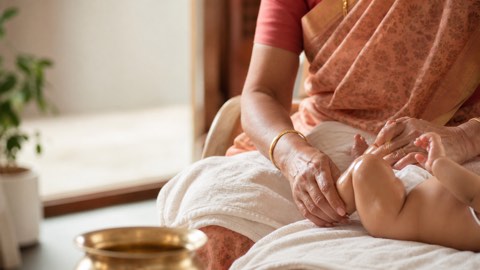
Either. A small plastic tub is easier on your back and safer than a deep bucket; the traditional lap-bath — baby lying along your outstretched legs while you sit and pour — is safe, controlled and free. What matters is your grip, the water depth, and never letting go.
Sources
Every clinical figure on this page is taken from the guidelines below. Where our numbers and your doctor's differ, ask which guideline they follow.
- WHO. Postnatal care of the mother and newborn (2013)Supports the recommendation to delay the newborn's first bath (to preserve vernix) and the guidance that sponge baths should be used until the umbilical cord stump has separated and healed.
- AAP. Bathing Your Baby (HealthyChildren.org) (2022)Supports the guidance on sponge baths until the cord stump falls off, washing face-to-nappy area in order from cleanest to dirtiest, using a shallow water depth of around 5–8 cm, and the safety rule never to leave a baby unattended in or near water.
- NHS. Washing and bathing your baby (2023)Supports the recommendation of two to three baths per week for newborns, keeping the umbilical stump dry during sponge baths, testing bath water temperature with an elbow or inner wrist, and the safe bathing technique of supporting the baby's head and neck throughout.
- NICE. Postnatal care (NG194) (2021)Supports keeping the umbilical cord stump clean and dry, delaying the first bath after birth to allow vernix to absorb, and advising families on safe newborn hygiene practices in the postnatal period.
- CDC. Drowning Prevention (2023)Supports the safety warning that babies can drown in very small amounts of water and must never be left unattended in or near water, even briefly.
Reviewed by
- Nakul Phatak — CEO, theAsianparent India & IndonesiaHead of theAsianparent India; father of one
- Roshni Chugani — Head of Marketing, theAsianparent India & Singapore12 years in the mother-and-baby space; mother of two
Published by: theAsianparent editorial team