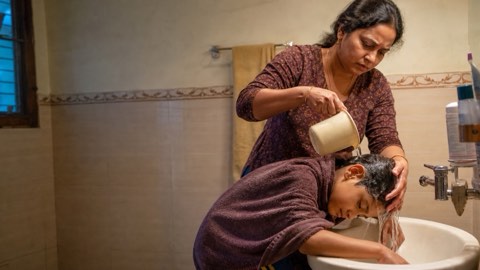
Why you do not need to brush your child's hair every day

Hundred strokes a night is a Victorian instruction that ruins textured hair. Here is what brushing actually does, how often it is needed, and how to detangle without a fight.
What brushing does and does not do
Brushing distributes the scalp's natural oil down the hair shaft and removes shed hairs and dust. That is the whole benefit, and it is achieved in a minute or two, not a hundred strokes.
What repeated brushing does to Indian hair — which is most often thick, wavy or curly — is mechanical damage: it lifts the cuticle, snaps strands mid-shaft, and turns a defined curl into frizz. Dry-brushing curly hair is the single most common cause of the breakage parents then blame on shampoo.
The 'brush a hundred times for shine' rule came from an era of fine straight hair, brushes made of boar bristle, and hair washed once a fortnight. None of those conditions apply in an Indian bathroom in June.
How often, by hair type
Straight or fine hair: once or twice a day is fine — usually a quick brush in the morning and, if the hair is long, a gentle one before bed to prevent overnight tangling.
Wavy or thick hair: once a day is plenty, and it is best done on damp hair with conditioner or a little oil, using a wide-toothed comb rather than a bristle brush.
Curly and very curly hair: detangle on wash day, when the hair is wet and slippery with conditioner, and leave it alone in between. Brushing dry curls every morning destroys the curl pattern and creates the frizz the brushing was meant to fix.
Babies and toddlers: a soft baby brush is for cradle cap and for the pleasure of it, not for grooming. Almost no toddler needs daily brushing.


Detangling without tears
Start at the ends and work upward in sections, holding the hair above where you are combing so the pull does not reach the scalp. Starting at the roots and dragging down is what makes children scream and hair snap.
Work on damp hair with a leave-in conditioner, a detangling spray or a light oil. Use a wide-toothed comb; keep the fine comb for lice checks only.
For very tangled hair, take five minutes rather than two, put on a song, and let the child hold a mirror or a toy. Hair-brushing battles usually start with one painful session that the child then remembers for months.
Long hair should be plaited or tied loosely for sleep and for school — a plait prevents more tangling than any amount of brushing corrects. Avoid very tight braids, high tight ponytails and heavy clips worn daily; traction damage at the hairline in Indian schoolgirls is common and preventable.
Oiling, and when to see a doctor
Oiling is worth keeping. A gentle warm-oil massage once or twice a week softens hair, makes detangling far easier, and is a comfortable ritual — coconut oil has the best evidence for reducing protein loss from hair. What it does not do is grow hair thicker or prevent hair fall, whatever the advertisement says.
Do not leave heavy oil in for days, particularly in humid weather — it traps dust and can worsen dandruff and fungal scalp problems.
See a doctor for: patchy hair loss with smooth bald spots, scaly itchy patches with broken hairs (a fungal scalp infection needs oral treatment, not shampoo), sudden diffuse hair fall, hair loss with tiredness and pallor (get haemoglobin and thyroid checked), or any hair pulling by the child themselves, which can signal anxiety.
And for lice, which every Indian school has in circulation: treat with a proper medicated lotion from a pharmacy, comb with a fine nit comb on wet conditioned hair every three days for two weeks, treat everyone affected at home on the same day, and tell the school without embarrassment. Lice are about proximity, not cleanliness.
Frequently asked questions
My daughter's hair tangles into a knot at the nape every day. What now?
That spot rubs against collars and pillows. Plait it for school and sleep, condition it well on wash day, and detangle that section first while your patience is fresh.
Should I cut my baby's hair (mundan) to make it grow thicker?
Shaving does not change the thickness or texture of hair that grows afterwards; that is decided by genetics. Do it for the ceremony if your family keeps it, with a clean blade and a calm setting, not for the hair.
Is a brush or a comb better?
For most Indian hair, a wide-toothed comb, plus a soft brush for smoothing straight hair. Fine-bristle brushes and round styling brushes are for adults, not children.
How do I get my son to sit still for it?
Keep it under two minutes, do it at the same point in the routine every day, and give him the choice of when within a small window. And check the comb — half of all resistance is a comb that hurts.
Reviewed by
- Nakul Phatak — CEO, theAsianparent India & IndonesiaHead of theAsianparent India; father of one
- Roshni Chugani — Head of Marketing, theAsianparent India & Singapore12 years in the mother-and-baby space; mother of two
Published by: theAsianparent editorial team