Why babies cry the moment you put them down

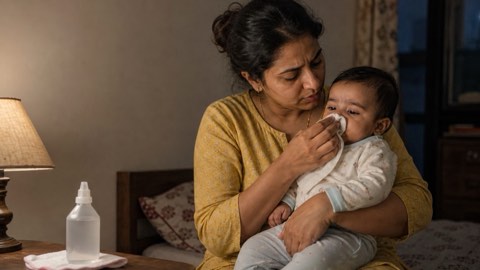
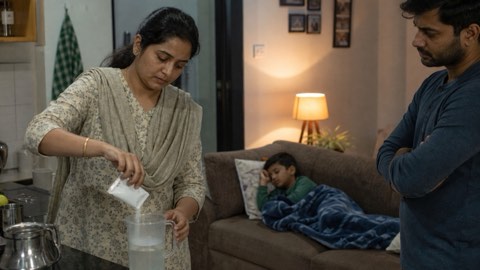
A baby who sleeps beautifully in your arms and screams the moment they touch the mattress is not being difficult. They are doing exactly what a newborn is built to do.
What is actually happening
Human babies are born far earlier in their development than most mammals, and being held is their normal environment. Skin contact regulates a newborn's temperature, heart rate and breathing. A mattress does none of that.
The transfer itself triggers the Moro reflex — the sudden arms-out startle when a baby feels a change in position or a loss of support. That reflex is present until around four to six months and is the direct cause of most failed transfers.
There is also a temperature drop from a warm chest to a cool sheet, a change in smell, and a change in sound.
And the timing: babies enter light sleep first and only reach deep sleep after about twenty minutes. Putting a baby down at five minutes almost always fails.
This is normal behaviour in a healthy newborn, and it eases substantially between three and six months.
What helps
Wait longer. Twenty minutes of holding after they fall asleep, until the limbs go properly limp and an arm lifted gently drops. This single change fixes more transfers than everything else combined.
Warm the surface first with your hand or a warm cloth, removed before you lay them down.
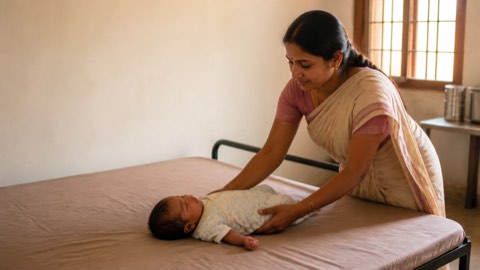
Go down bottom first, then back, then head — head last, and keep your hands on them for a slow count of thirty after they are down.
Swaddle for the first months if your baby likes it, which contains the startle. Stop swaddling as soon as there is any sign of rolling, and never swaddle tightly around the hips.
Keep a hand firmly on the chest, or lean over so they still feel and smell you, and withdraw gradually rather than stepping straight back.
White noise on before the transfer, continuing through it, so the sound does not change.
And accept contact naps in the newborn weeks. A held nap is a real nap and it does not create a problem you will pay for later.

Safety, because tiredness is when this goes wrong
Whatever the settling difficulty, the sleep surface itself is not negotiable: on the back, on a firm flat mattress, with nothing else in the space — no pillow, no quilt, no bumper, no soft toy.
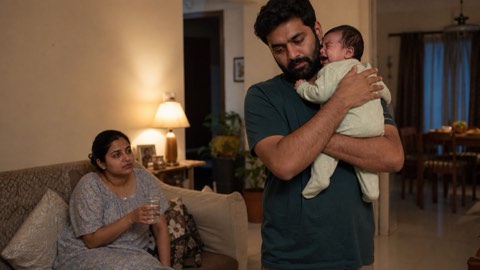
Never fall asleep holding a baby on a sofa or armchair. This is far more dangerous than a bed, and it is exactly what exhausted parents do at 4 a.m. after a failed transfer.
Do not leave a baby sleeping unsupervised in a car seat, bouncer, swing or jhula. The semi-upright position can let a newborn's head fall forward and obstruct their airway.
If you use a sling, keep the baby high and upright, face visible, chin off the chest, and check them frequently.
If you co-sleep, do it deliberately and set the bed up for it — firm mattress, no gaps, no heavy covers near the baby, nobody who has drunk alcohol, smoked or taken sedating medication. Talk to your paediatrician about your own situation.
When to see a doctor
See a doctor if the crying is inconsolable for hours, comes with arching, drawing up of the legs, forceful vomiting, blood in stool, poor weight gain, or refusing feeds — reflux and cow's milk protein allergy both present this way and both are treatable.
Urgently: a baby who is floppy, difficult to rouse, breathing fast or noisily, has a fever under three months of age, or has a high-pitched unusual cry. Call 108 if you cannot travel quickly.
And raise your own state honestly. If you feel you might shake or harm the baby, put them down safely in the cot, walk out of the room and call someone. That impulse is far more common than anyone admits and it is a reason to get help, not to feel ashamed.
This article is general information, not medical advice, and is no substitute for personal medical advice.
Frequently asked questions
Am I spoiling my baby by holding them?
No. You cannot spoil a newborn, and responding to a young baby builds security rather than dependence.
When will it get easier?
For most babies, noticeably between three and six months as the startle reflex fades and sleep cycles mature.
Should I let them cry it out?
Not in the newborn period. Approaches involving leaving a baby to cry are not appropriate under about four to six months, and even then they are a choice rather than a requirement.
Everyone says I am making a rod for my own back.
There is no evidence that responding to a newborn creates later sleep problems. It is the most common advice given and among the least supported.
Sources
Every clinical figure on this page is taken from the guidelines below. Where our numbers and your doctor's differ, ask which guideline they follow.
- AAP. Safe Sleep: Back to Sleep, Every Sleep (2022)Backs the page's safe sleep instructions: back-sleeping on a firm flat surface, no pillows, quilts, bumpers or soft toys in the sleep space, and the warning against leaving babies unsupervised in car seats, bouncers or swings.
- NHS. Reducing the risk of sudden infant death syndrome (SIDS) (2023)Backs the co-sleeping safety conditions listed on the page (firm mattress, no heavy covers, no alcohol, smoking or sedating medication) and the swaddling advice to stop at first signs of rolling and never swaddle tightly around the hips.
- WHO. Recommendations for care of the preterm or low-birth-weight infant: skin-to-skin contact (2023)Backs the claim that skin contact regulates a newborn's temperature, heart rate and breathing.
- NICE. Postnatal care (NG194) (2021)Backs the page's advice that responding to a young baby builds security rather than dependence, and the guidance that cry-it-out approaches are not appropriate in the newborn period.
- NIH. Moro reflex – MedlinePlus Medical Encyclopedia (2022)Backs the description of the Moro (startle) reflex — arms-out response to a change in position or loss of support — and its normal disappearance at around three to four months (up to six months).
Reviewed by
- Nakul Phatak — CEO, theAsianparent India & IndonesiaHead of theAsianparent India; father of one
- Roshni Chugani — Head of Marketing, theAsianparent India & Singapore12 years in the mother-and-baby space; mother of two
Published by: theAsianparent editorial team