Baby walkers: why paediatricians say no, and what to use instead

The walker is the most commonly gifted item in Indian babyhood and the one paediatricians most consistently advise against. Here is why, and what works instead.
What walkers actually do
They delay walking slightly rather than speeding it up. A baby in a walker is held upright by a seat, pushes with the toes, and misses the floor work — rolling, crawling, pulling up, cruising — that builds the trunk and hip strength walking needs.
They cause injuries at a rate that led Canada to ban their sale outright and several paediatric bodies to call for the same. The mechanism is simple: a walker gives a baby the speed of a running adult and the judgement of an eight-month-old, near stairs, kitchens, buckets and hot vessels.
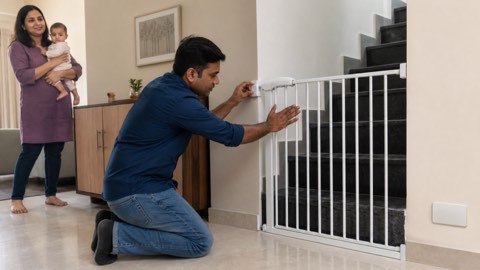
In Indian homes the specific dangers are stairs without gates, thresholds that tip the walker, water buckets, and the kitchen at floor level. A walker also puts a baby at exactly the height of a hot cooking vessel or a diya.
Jumpers, bouncers and seats
Door-frame jumpers carry their own risks — falls if the clamp slips, head knocks against the frame, and the same toe-pushing pattern. If used at all, keep sessions very short.
Stationary activity centres are safer than walkers because they do not move, but a baby held upright in a seat is still not doing the floor work. Fifteen or twenty minutes at a time is plenty.
The general principle: any device that holds a baby upright is a container. Containers are useful for keeping a baby safe while you cook or shower, and they are not development.
What actually builds walking
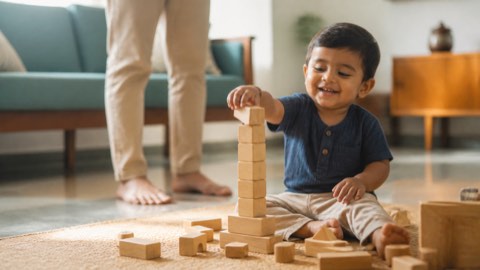
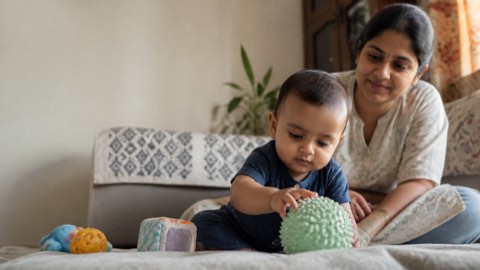
Floor time, in quantity, on a firm surface with space to move. This is the whole answer, and it is free.
Tummy time from the newborn weeks, supervised, several short sessions a day, building the neck, shoulder and trunk strength everything else depends on.
Furniture at the right height to pull up on, a clear cruising route along a sofa or low table, and a sturdy push-along toy or a weighted cardboard box once they are cruising.
Bare feet indoors, which is better for balance and foot development than any shoe. Shoes are for outdoors, once walking outside is established.
And patience: the normal range for independent walking runs from about nine to eighteen months. A baby who is not walking at thirteen months and is otherwise developing well is not behind.
When to see a doctor
Emergency after any walker or jumper fall: loss of consciousness even briefly, repeated vomiting, drowsiness, a fit, unequal pupils, or fluid from the nose or ears — 108 or straight to hospital. Also any burn or scald.
Book an assessment if: a baby is not bearing weight on the legs by around ten months, not pulling to stand by twelve months, not walking by eighteen months, walking persistently on toes beyond two years, using only one side of the body, or has lost a skill.
This article is general information, not medical advice, and is no substitute for personal medical advice. For any decision about your or your child's health, please consult your doctor.
Frequently asked questions
We were all put in walkers and we are fine.
Most children are, and the injuries that happen are severe when they do. The evidence on delayed walking is separate and consistent. Neither makes it a good buy.
My mother-in-law has already bought one.
Accept it graciously and use it as a stationary play seat with the wheels removed, or keep it for very short supervised stretches on a flat floor away from stairs, kitchen and buckets. Framing it as the doctor's advice usually settles the conversation.
What can I put the baby in while I cook?
A high chair or a play yard in the room with you, or a carrier on your back if the stove is off. Nothing on wheels near a kitchen.
Do shoes help a baby learn to walk?
No. Bare feet indoors are best. Soft-soled shoes are for outdoor surfaces, and firm shoes come once outdoor walking is confident.
Sources
Every clinical figure on this page is taken from the guidelines below. Where our numbers and your doctor's differ, ask which guideline they follow.
- AAP. Baby Walkers: A Dangerous Choice (2023)Supports the claims that baby walkers cause injuries serious enough for paediatric bodies to call for bans, that walkers give infants adult-level speed without the judgement to match, and that stationary activity centres are safer alternatives.
- WHO. Guidelines on physical activity, sedentary behaviour and sleep for children under 5 years of age (2019)Supports the recommendation that floor-based free movement and tummy time in quantity are essential for infant motor development, and that time spent restrained in seats should be limited.
- IAP. IAP Guidelines on Developmental Surveillance and Promotion of Optimal Development (2014)Supports the developmental milestones cited on the page — bearing weight on legs by around ten months, pulling to stand by twelve months, and independent walking by eighteen months as the upper limit of normal.
- NICE. Developmental follow-up of children and young people born preterm (NG72) (2017)Supports the recommendation to seek assessment if a child is not walking by eighteen months or has lost a previously acquired motor skill, as indicators warranting clinical review.
Reviewed by
- Nakul Phatak — CEO, theAsianparent India & IndonesiaHead of theAsianparent India; father of one
- Roshni Chugani — Head of Marketing, theAsianparent India & Singapore12 years in the mother-and-baby space; mother of two
Published by: theAsianparent editorial team