Vastu for a child's room: what it says, and what actually helps

Almost every Indian family building or arranging a child's room hears vastu advice, usually from someone certain about it. Here is what the tradition actually says — and what changes a child's sleep and concentration whichever direction the bed faces.
What vastu says
Vastu shastra is a body of traditional Indian architectural guidance, thousands of years old, built around the eight directions and the idea that a building's orientation shapes the wellbeing of the people inside it. It is followed seriously by a great many Indian families, and it is worth knowing what it actually recommends rather than the half-remembered version relatives pass on.
The room itself: the west or north-west of the house is the usual recommendation for children, with the south-west generally reserved for the parents' room and considered too heavy for a child. The north-east is preferred for prayer and study rather than sleep.
Sleeping direction: the head to the south or east, and the head to the north avoided — this is the single most repeated piece of vastu advice in Indian homes. East is associated with learning and growth, south with rest.
The study table: facing north or east while studying, the table away from the wall rather than pushed against it, and the child not sitting with their back to the door. A beam directly overhead is avoided.
Other common points: no mirror facing the bed, no bed directly under a beam, light colours rather than dark or aggressive ones, the door opening clockwise, and no clutter or broken things stored under the bed.
You will also hear a great deal that is not classical vastu at all — pyramid stickers, expensive yantras, and 'vastu correction' services. Those are a modern commercial layer sold on top of the tradition, and even people who follow vastu closely tend to be sceptical of them.
What the evidence shows
There is no scientific evidence that the compass direction a child sleeps in affects their health, intelligence, behaviour or exam results. The magnetic-field explanations sometimes offered for the head-north rule do not hold up: the earth's magnetic field is far too weak to influence the human body in the way those explanations claim, and the direction of a bed changes nothing measurable.
The same is true of the study-table direction, the door's swing, and the placement of a mirror. No study has shown an effect, and none of these are things researchers would expect to matter.
This is worth saying plainly, because the cost of believing otherwise is real: families spend money on remedies, refuse otherwise good flats over the direction of a doorway, and — most damagingly — look for something in the house to blame when a child is ill or does badly in an exam.
None of which makes the tradition worthless to follow. If arranging a room this way brings comfort, costs nothing, and does not compromise anything else, there is no reason not to. The problems begin when it overrides safety, or when it becomes a stick to beat someone with.
Where vastu and good sense happen to agree
Several vastu recommendations line up with things that genuinely help, for reasons that have nothing to do with direction.
Light from the north or east. Vastu favours it; so does anyone who has tried to get a child to sleep in a room that takes the full afternoon sun. In most of India, a west-facing bedroom is hot until late evening, and heat is one of the commonest reasons small children wake. If you have a choice of rooms, the cooler one is the better one — and it will often be the one vastu recommends.
No clutter, nothing broken stored under the bed. The reasoning in vastu is about energy; the practical reasoning is that a cluttered room is harder to sleep in, harder to study in, and in a small child's room is a genuine safety issue. Same instruction, better reason.
A study table not pushed into a dark corner, and the child not sitting with their back to the door. Vastu frames this in terms of direction and authority. In practice, a desk with good light and a view of the room feels less like a punishment, and children work at it for longer.
No mirror facing the bed. Whatever the tradition means by it, a small child waking at night and seeing movement in a mirror is a real and common source of night fear.
Light colours on the walls. Vastu prefers them; so does anyone who wants a small room to feel bigger and a child to settle in it.
The things that actually change a child's room
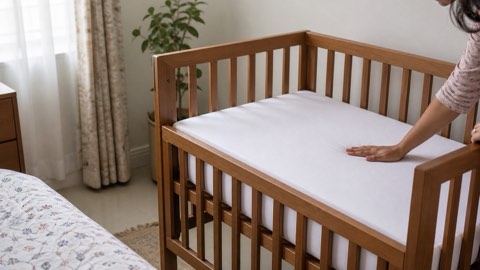
Safe sleep, which overrides every other consideration in this article. For a baby under one: a firm flat mattress, on the back, with nothing else in the sleep space — no pillow, no quilt, no bumpers, no soft toys. Never place a cot under a window with blind or curtain cords within reach, and never against a heater. If a vastu recommendation and a safe-sleep rule ever conflict, the safe-sleep rule wins, every time. Our cot and safe-sleep guide covers the detail.
Temperature and ventilation. A room that is too hot is the single most common reason Indian babies and toddlers sleep badly. Cross-ventilation, a fan positioned so it does not blow directly on the child, and curtains that actually block afternoon heat will do more than any arrangement of furniture.
Darkness at night and daylight in the morning. Blackout curtains genuinely help a child sleep later; light in the morning helps the body clock settle. This is one of the few room changes with real evidence behind it.
The desk, at the right height. A child's feet should reach the floor and their elbows sit at roughly desk height. Most children in Indian homes study at a table built for an adult, with their shoulders up around their ears, and it shows in how long they last. A cushion on the chair and a box under the feet costs nothing and fixes most of it.
Light on the page from the side opposite the writing hand, so the hand does not cast a shadow across the work — left side for a right-handed child. This one matters more than the direction the table faces.
Screens out of the bedroom, particularly in the hour before sleep, and the study table not doubling as a gaming station. Our page on screens before bed goes into what the research actually shows.
And storage a child can reach and use themselves, which is the difference between a room that stays tidy and one that is tidied by an exhausted parent every evening.
When vastu becomes a problem
When it costs real money. Paid vastu corrections, structural changes to a rented flat, replacing furniture that was perfectly good — this is money that would do more as a fan, blackout curtains, a decent mattress or a desk lamp.
When it overrides safety. Moving a cot to a particular corner where the only available spot is under a window with cords, or against an outside wall that bakes in the afternoon, is a bad trade. So is refusing to use the coolest, quietest room in the house because of its direction.
When it becomes blame. A child's fever, a poor result, a difficult phase — none of these are caused by the direction of a bed, and a mother should not be told they were. This is where the tradition does its real damage in Indian families, and it is worth heading off before it starts.
When it delays medical care. A child who is unwell needs a doctor, not a remedy. If anyone in the family is proposing to wait and adjust the room first, that is the point to stop the conversation.
Handling relatives: the version that works is usually agreement on the cheap things and quiet firmness on the rest. Moving a bed is free and keeps the peace. Refusing to move a cot away from a safe wall, or refusing to pay for a correction, is worth holding.
Frequently asked questions
Which direction should a child sleep in?
Vastu says head to the south or east, and avoids head to the north. There is no evidence that direction affects sleep or health. Whether your child sleeps well has far more to do with the room's temperature, darkness and routine.
Is it bad if my child's bed faces north?
Not by any measure that has ever been tested. If it worries someone in the family and the bed can be moved for free, move it; if it cannot, nothing is being risked.
Which direction should the study table face?
North or east, according to vastu. What actually helps a child work is good light, a chair at the right height, feet on the floor, and no screen within reach.
We are renting and cannot change anything.
Then nothing is lost. Vastu is not a set of rules a family can fail; it is guidance for a house being built. Put your effort into the things that do change outcomes — heat, light, noise, a comfortable place to work.
Should we pay for a vastu consultation for the nursery?
That is your call, and it is worth knowing that no part of it has been shown to affect a child's health or development. The same money spent on ventilation, a good mattress and blackout curtains has an effect you will notice within a week.
Reviewed by
- Nakul Phatak — CEO, theAsianparent India & IndonesiaHead of theAsianparent India; father of one
- Roshni Chugani — Head of Marketing, theAsianparent India & Singapore12 years in the mother-and-baby space; mother of two
Published by: theAsianparent editorial team