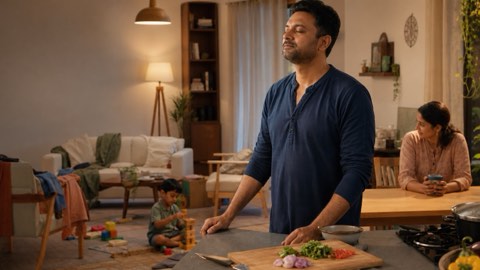
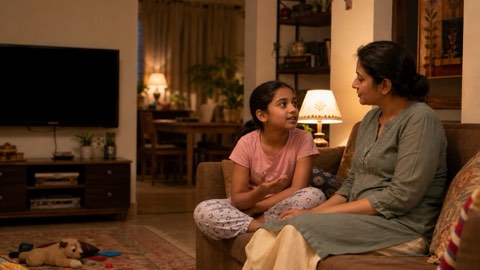
When your child still hits, kicks or bites you

Being hit by your own child is humiliating in front of relatives and frightening on your own. It is also common, it is a communication problem before it is a discipline problem, and it responds to a consistent response.
Why it happens, by age
Under three: no words fast enough for a big feeling, and no brake. The child wants, cannot say, and the body acts. This is developmental rather than moral.
Three to six: usually frustration, tiredness, hunger or an attempt to control a situation — plus, often, a discovery that hitting produces a large and immediate reaction.
Six and older: this is the age at which hitting a parent stops being a stage and starts being a signal. Look for what has changed — school stress, bullying, a new sibling, family conflict, a lot of screen exposure to aggression, or a child copying what they see adults do at home.
That last one deserves saying plainly: children who are smacked hit more. If hitting is part of the household's discipline, the child is doing what they have been taught, and that is where the change has to start.
What to do in the moment
Block rather than grab: hold the arm or move out of range, calmly. Say a short, flat sentence — 'I will not let you hit me' — and stop talking. Long explanations mid-episode do nothing.
Move the child, or move yourself. 'I am going to sit over here until you are calm' is a legitimate and powerful response, and it models exactly what you want them to do with anger.
Do not hit back, do not bite back to 'show how it feels', and do not laugh — all three teach the wrong lesson, and the third is surprisingly common with a small child whose attempt looks comical.
When calm, do the repair briefly: name the feeling, give the alternative ('you were angry — you can say I am angry, or stamp your feet'), and have them make it right in some small way. Then move on without a lecture.
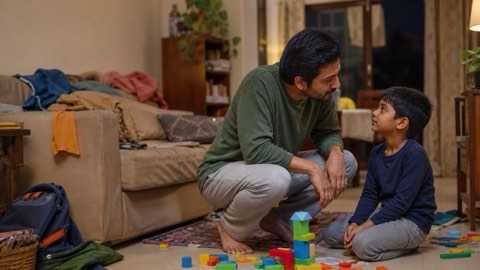
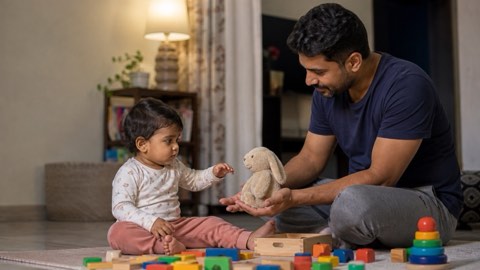
Stopping the pattern
Track when it happens for a week. Almost every family finds a pattern — evenings, screen-time endings, homework, hunger, transitions, or one particular adult. Change the trigger and half the incidents disappear.
Rehearse the alternative when everyone is calm: what to do with angry hands, what words to use, where to go. A child cannot learn a new response in the middle of losing control.
Be consistent across adults. The commonest reason hitting persists in Indian homes is that one adult treats it as a serious rule and another laughs, indulges or hits back.
And notice the good: name it out loud when they are angry and do not hit. Attention for the wanted behaviour changes it faster than any consequence for the unwanted one.
When to get help
Talk to a paediatrician, school counsellor or child psychologist if: hitting is frequent and intense beyond about age five or six; the child injures people or animals; aggression comes with a marked change in mood, sleep or school performance; there is self-harm; the child seems unable to calm at all; or aggression appears alongside speech delay or loss of skills.
Also seek help for yourself if you are frightened of your child, if you have hit back harder than you intended, or if the incidents leave you shaking with rage — that is a signal about capacity, not character. Tele-MANAS on 14416 is free, confidential and answers parents too.
If there is violence between adults in the home, treat that as the first thing to address. Children who witness it act it out, and no behaviour plan works around it.
Frequently asked questions
He only hits me, never his father or teacher. Why?
Because you are the safe person. Children release their worst behaviour where the relationship is most secure. It is not a verdict on your parenting, though it does mean your response needs to be as firm and consistent as the one he gets elsewhere.
The whole family says one slap will end it.
It usually ends the incident and increases the behaviour over months, because it demonstrates that hitting is what big people do when angry. Our guide on discipline without hitting has the alternatives.
My child hits me in public and everyone stares.
Deal with the child, not the audience: block, say the sentence, and leave. Discuss it later at home. Nothing improves with a crowd and a humiliated child.
He apologises and then does it again the next day.
Apology is easy; the alternative behaviour is what takes practice. Focus on rehearsing what to do with anger, on the triggers, and on consistency — improvement is measured in weeks, not days.
Reviewed by
- Nakul Phatak — CEO, theAsianparent India & IndonesiaHead of theAsianparent India; father of one
- Roshni Chugani — Head of Marketing, theAsianparent India & Singapore12 years in the mother-and-baby space; mother of two
Published by: theAsianparent editorial team