Toilet training: readiness signs, the method, and why starting early backfires

Indian families often start toilet training at one year and finish at three. Starting when the child is ready takes weeks instead of years — here is how to tell, and what to do.
Readiness beats the calendar
Bladder and bowel control is a physical skill that arrives with nerve maturity, usually between eighteen months and three years. Training before that produces a child who is held over a potty on schedule — which trains the parent, not the child.
The signs to wait for: staying dry for two hours or more; telling you (in words, gestures or a distinctive squat) before or just after going; showing interest in the toilet and in others using it; being able to pull pants up and down; disliking a wet or soiled nappy; and being able to follow a two-step instruction.
Summer is the practical season for it in most of India — fewer clothes, faster drying, easier to let a child run bare-bottomed at home. And pick a calm stretch: not the week a sibling arrives, not the week playschool starts.
The method
Get the equipment familiar first: a floor potty (safer and less frightening than a high toilet) or a child seat with a foot stool so the feet are supported — feet dangling makes pushing hard. Let the child sit on it clothed for a few days, watch you and older siblings, and name what happens.
Then switch to underwear during waking hours at home — not pull-ups, which feel like nappies and slow everything down. Offer the potty at wake-up, after meals, before the bath and before going out, roughly every ninety minutes, without turning it into an argument.
Praise the sitting, not just the result, and keep the praise mild — big celebrations create performance pressure. When an accident happens, and dozens will, say 'that's okay, next time we use the potty' and change without irritation. Punishment, shaming and comparisons with cousins delay training more than anything else.
Teach the whole routine as one thing: wipe (front to back for girls), flush, wash hands with soap. That habit built now is worth more than the training itself.

Accidents, regression and the poo problem
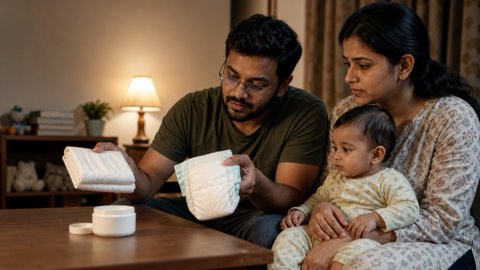
Expect regression around a new sibling, a house move, starting school, or an illness. Go back a step without comment, hold the routine, and it usually recovers in a week or two.
Stool withholding is common and worth taking seriously: a child who has had one painful hard stool may hold on for days, which makes the next one harder still. Fix the constipation — water, fruit, fibre, less milk, and a doctor's help if needed — before pushing on with training. A child who is frightened of the potty for this reason cannot be persuaded out of it.
Some children train for wee long before poo, or will only pass a stool in a nappy. Both are common. Let them have the nappy for that one job while the rest proceeds; forcing it creates withholding.
Night-time and the school question
Night dryness is a separate, later milestone that depends on a hormone that reduces night urine production — it is not a skill and cannot be trained. Many children are not reliably dry at night until four or five, and bedwetting up to age seven is common and needs no treatment beyond patience, a mat, and no shaming.
Practical steps: limit drinks in the last hour before bed, toilet immediately before sleep, a night light and a clear path to the toilet, and a waterproof sheet. Lifting a sleeping child to the toilet is optional and does not speed anything up.
Many playschools ask for children to be toilet trained. Talk to them honestly rather than rushing the child — a good school expects accidents from three-year-olds and handles them. Send spare clothes daily and tell the teacher the words your child uses.
Frequently asked questions
My mother-in-law says her children were trained by one year
was that different? — What she remembers is elimination timing: an adult reading the child's signals and holding them over the potty at the right moment. It works, it keeps nappies down, and it is genuinely useful — but it is not the child controlling their own bladder, which is what arrives later.
Should I use a reward chart or chocolates?
Small, brief rewards can help start a reluctant child, and stickers work better than sweets. Fade them out within a few weeks — the goal is a child who goes because they feel the need, not one who negotiates.
When should I worry?
Talk to the doctor if: there is no interest at all by three and a half; a child who was trained starts wetting again suddenly (which can signal a urinary infection, diabetes or stress); there is pain or burning on passing urine; dribbling all day; hard, painful stools with holding; or soiling in an older child.
How do we manage using public and squat toilets?
Practise squatting at home; many children find a squat toilet easier than a high seat once used to it. Carry your own paper or a small water bottle, wipes, hand sanitiser and a change of clothes, and teach the child to touch as little as possible and wash hands properly afterwards.
Reviewed by
- Nakul Phatak — CEO, theAsianparent India & IndonesiaHead of theAsianparent India; father of one
- Roshni Chugani — Head of Marketing, theAsianparent India & Singapore12 years in the mother-and-baby space; mother of two
Published by: theAsianparent editorial team